
Outcome Delivery Incentives: A Powerful Tool for Water Company Accountability
Understanding performance-based regulation, financial rewards, environmental responsibilities, and the impact on household water bills.

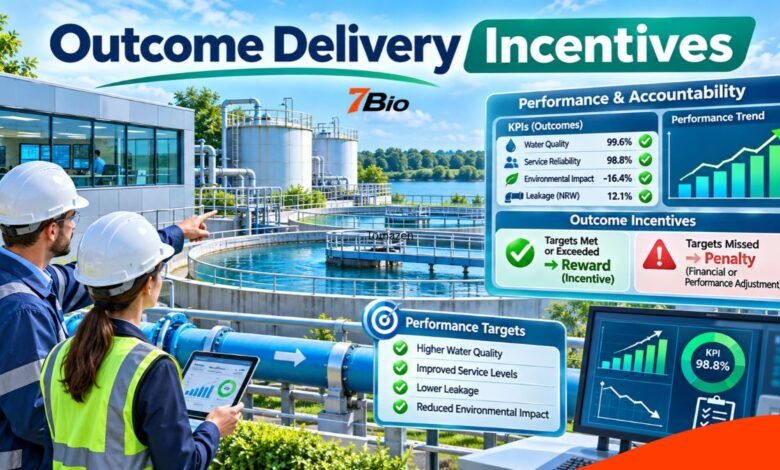
Outcome delivery incentives (ODIs) are regulatory mechanisms Ofwat uses to encourage water companies in England and Wales to achieve measurable improvements in customer service, operational reliability, and environmental performance. Companies that exceed specified targets may receive financial rewards, while those that fall short may face financial penalties.
The system links company revenue to the quality of service customers receive. Rather than assessing businesses solely on expenditure or infrastructure investment, Ofwat also examines the results of those activities.
Under the PR24 price review, covering 2025 to 2030, outcome delivery incentives remain an important part of water industry regulation. Understanding how they operate helps customers make sense of water bills, company performance reports, and regulatory decisions.
What Are Outcome Delivery Incentives?
Outcome delivery incentives are performance-based regulatory arrangements that attach financial or reputational consequences to specified service targets.
Ofwat, the economic regulator of the water industry in England and Wales, establishes performance commitments covering different aspects of water and wastewater services. Companies are subsequently assessed against these commitments.
When a financial incentive applies, the company may receive an outperformance payment for exceeding its target or face an underperformance payment for missing it.
The central principle is straightforward: companies should be financially encouraged to deliver meaningful improvements, not simply complete planned activities.
Replacing a pipe is an activity; reducing the water lost through that pipe is an outcome. This distinction helps explain why the regulatory framework places considerable emphasis on measurable results.
How Do Outcome Delivery Incentives Work?
The ODI process involves establishing targets, measuring actual performance, and determining the associated regulatory adjustments.
Setting Performance Commitments
Ofwat establishes performance commitments as part of its price review process. These commitments identify the services or outcomes against which water companies are assessed.
A performance commitment level, commonly abbreviated to PCL, specifies the expected standard for a particular reporting period.
Examples include reducing leakage, improving supply reliability and lowering the frequency of sewer flooding.
Measuring Company Performance
Water companies report their performance using established regulatory definitions and reporting requirements. Ofwat reviews the information and assesses whether companies have achieved their commitments.
A company can improve its performance compared with the previous year and still miss its regulatory target. Equally, the financial consequences depend on the precise incentive arrangements attached to that commitment.
Applying Financial Rewards and Penalties
Where financial outcome delivery incentives apply, performance differences are translated into monetary adjustments using predetermined rates and applicable protections.
These adjustments can influence the revenue a company is permitted to recover through customer charges.
The process links service delivery to business performance.
Key Components of the ODI Framework
Several regulatory terms are essential to understanding how the system operates.
| Component | Meaning |
|---|---|
| Performance commitment | A defined measure of service or operational performance |
| Performance commitment level | The expected target for that measure |
| ODI rate | The financial value associated with a specified performance difference |
| Outperformance payment | A potential reward for exceeding a target |
| Underperformance payment | A financial consequence for missing a target |
| Cap | A limit on financial rewards |
| Collar | A limit on financial exposure from underperformance |
| Deadband | A specified performance range in which an incentive payment does not apply |
Not every performance commitment has identical incentive arrangements. Rates, thresholds and protections can differ between companies and measures.
Outcome Delivery Incentives Under PR24
The 2024 price review, known as PR24, establishes the regulatory framework for water and wastewater companies between April 2025 and March 2030.
Ofwat published its final PR24 determinations in December 2024. The Competition and Markets Authority subsequently issued final redeterminations for five water companies in March 2026.
According to Ofwat, approximately 340 company-level performance commitments have associated ODIs across the 16 major water companies during the 2025–2030 regulatory period.
The framework covers environmental protection, customer experience, infrastructure reliability, and other operational priorities.
Outcome delivery incentives provide a mechanism to assess delivery throughout the regulatory period, rather than relying exclusively on an assessment at its conclusion.
Which Areas of Water Company Performance Are Measured?
Water Leakage
Leakage represents water lost from distribution networks and relevant supply pipes. Reducing these losses supports more efficient use of water resources and can help address pressure on existing infrastructure.
Financial incentives encourage companies to achieve their specified leakage reduction targets.
Sewer Flooding
Sewer flooding can cause considerable disruption to households, businesses and public spaces.
Ofwat measures internal and external sewer flooding through defined performance commitments. Relevant incentives encourage companies to reduce incidents and improve network reliability.
Environmental Pollution
Environmental performance includes measures relating to pollution incidents, storm overflows and other aspects of wastewater management.
These commitments link company performance to protecting rivers, coastal waters, and surrounding ecosystems.
However, meeting a performance commitment does not automatically demonstrate compliance with every environmental law or permit requirement.
Customer Experience
The regulatory framework also considers how customers experience water company services.
Measures such as the Customer Measure of Experience (C-MeX) and Developer Services Measure of Experience (D-MeX) encourage improvements in interactions with residential customers and developers.
Different customer groups may be assessed through separate measurement arrangements.
A Practical Example of an ODI Calculation
Consider a hypothetical water company with a target of 100 sewer flooding incidents during a reporting year.
Assume its applicable incentive rate is £5,000 per incident above or below the target, with no additional adjustments or risk protections.
| Actual performance | Illustrative financial result |
|---|---|
| 90 incidents | £50,000 reward |
| 100 incidents | No performance adjustment |
| 110 incidents | £50,000 penalty |
| 120 incidents | £100,000 penalty |
This example demonstrates the basic relationship between performance and financial consequences.
These figures are purely illustrative and do not represent an actual Ofwat incentive rate. Real calculations may involve different measurement units, thresholds, payment rates and regulatory protections.
How Outcome Delivery Incentives Affect Water Bills
One of the most significant features of the ODI framework is its potential influence on customer charges.
When companies receive underperformance adjustments, their permitted revenue may decrease. Conversely, outperformance payments can increase the amount they are permitted to recover.
However, customers should not assume that a company receiving a penalty will automatically reduce every household’s bill by the same amount.
Water charges also depend on infrastructure investment, inflation, operating costs and other regulatory adjustments.
A company’s bills could therefore increase overall even when an ODI penalty reduces the amount it would otherwise have been permitted to charge.
An ODI payment is a regulatory adjustment, not a personal compensation award.
Latest Outcome Delivery Incentive Developments in 2026
On October 14, 2026, Ofwat published its draft ODI determinations relating to water company performance during 2025–2026.
The proposals included a net £240 million reduction in customer bills, with £107 million intended to be reflected in charges during 2027–2028.
Ofwat identified Yorkshire Water and Thames Water as companies facing the largest proposed downward adjustments from April 2027. Severn Trent Water and Northumbrian Water were identified as receiving the largest proposed upward performance adjustments.
As of November 24, 2026, these figures remain draft proposals. Ofwat’s final determinations are scheduled for December 15, 2026, with the relevant charging changes taking effect from April 1, 2027.
The precise impact will vary by company, customer category, and other elements of the charging framework.
Benefits of Outcome Delivery Incentives
Stronger Corporate Accountability
The system provides measurable criteria against which water companies can be assessed. This allows regulators, customers and investors to examine whether businesses are delivering their commitments.
Greater Focus on Service Quality
Linking revenue to service performance encourages companies to consider the practical results of their operational decisions.
Environmental Responsibility
Financial consequences associated with environmental measures can strengthen the business case for addressing pollution, leakage, and wastewater management problems.
Improved Performance Transparency
Published performance reports and regulatory determinations provide information that helps stakeholders understand company achievements and shortcomings.
These benefits depend on well-designed targets, accurate reporting, and effective regulatory oversight.
Limitations and Challenges of the ODI System
Outcome delivery incentives are not a complete solution to every problem within the water industry.
Poorly designed targets could encourage companies to prioritize activities that attract financial rewards while giving less attention to issues outside the measured framework.
It is also challenging to distinguish management performance from external factors such as severe weather, population growth, and changing environmental conditions.
Reliable reporting is particularly important. If performance data is inaccurate or inconsistent, the resulting financial adjustments may not properly reflect service quality.
Financial incentives must therefore operate alongside environmental regulation, infrastructure planning, customer protection and enforcement.
Outcome Delivery Incentives vs Price Control Deliverables
| Feature | Outcome Delivery Incentives | Price Control Deliverables |
|---|---|---|
| Primary focus | Measurable service outcomes | Delivery of specified funded improvements |
| Assessment | Performance against targets | Delivery against agreed requirements |
| Example | Reduced leakage | Completion of a funded infrastructure scheme |
| Purpose | Encourage improved results | Protect customers where funded work is not delivered as required |
Together, these mechanisms help Ofwat examine both what companies deliver and whether customers receive the intended benefits.
How Customers Can Check Water Company Performance
Customers interested in understanding their provider’s performance can consult Ofwat’s Water Company Operational Performance Report, company annual performance reports and published ODI determinations.
When reviewing these documents, customers should consider the reporting year, applicable targets, actual results, and whether financial adjustments are provisional or final.
Looking at several performance measures provides a more balanced picture than relying on a single reward or penalty.
FAQs
1. What does ODI stand for in the water industry?
ODI stands for Outcome Delivery Incentive. It describes a regulatory mechanism that links water company performance to financial or reputational consequences.
2. Who determines outcome delivery incentives?
Ofwat establishes the incentive framework for regulated water companies in England and Wales, subject to applicable regulatory processes and any relevant CMA redeterminations.
3. Are all ODIs financial?
No. Although many have financial consequences, some performance measures operate through reputational incentives and public reporting.
4. Are ODI penalties the same as regulatory fines?
No. ODI penalties arise through performance-related regulatory adjustments. Enforcement fines are separate mechanisms that may apply when companies breach relevant obligations.
5. Can customers apply directly for an ODI refund?
ODI adjustments are generally incorporated into regulated charges rather than distributed through individual refund applications. Separate customer compensation arrangements may apply in particular circumstances.
6. Does the Ofwat ODI framework apply throughout the UK?
No. The framework discussed here applies to regulated water companies in England and Wales. Scotland and Northern Ireland have different water industry arrangements.
Final Takeaway
Outcome delivery incentives connect water company financial performance with measurable customer and environmental outcomes.
Under PR24, these incentives encourage companies to improve operational reliability, reduce environmental harm and deliver the services customers expect.
Their effectiveness ultimately depends on meaningful targets, accurate performance measurement and consistent regulatory oversight. For customers, understanding the framework provides valuable insight into company accountability and the factors influencing future water bills.