
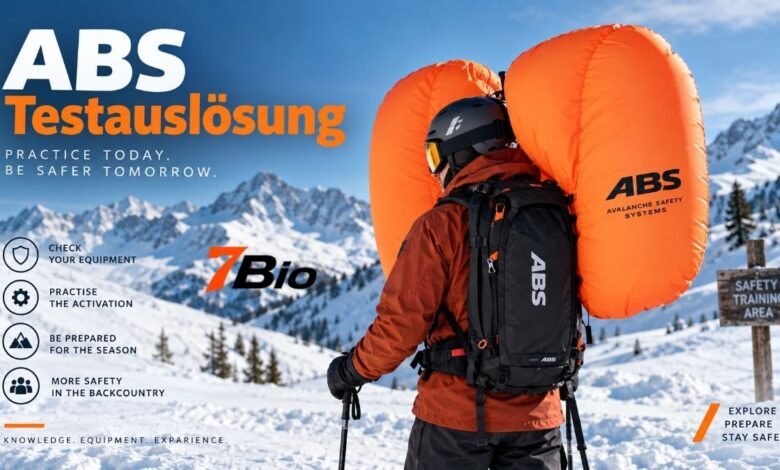
ABS Testauslösung most accurately refers to a test or training deployment of an ABS® avalanche-airbag system. ABS uses the German term Testauslösung to describe a deliberate deployment designed to check the equipment and help users practice pulling the activation handle before they need it in an emergency.
This distinction matters because current web results also use the phrase for automotive anti-lock braking-system diagnostics. That interpretation is possible linguistically, but the exact term has a strong, direct connection to the ABS avalanche-airbag brand and its official service guidance.
For skiers, snowboarders, and others traveling in avalanche terrain, the useful question is not simply what the phrase translates to, but how a test deployment works, when ABS recommends one, and what needs to happen afterward.
Quick Answer
An ABS Testauslösung is a planned activation of an ABS avalanche airbag. ABS currently recommends a training deployment with a filled cartridge before each season, while some EasyTech systems also let you practice the pulling motion without deploying the airbag. Exact procedures depend on the airbag generation, so the manual for the specific model takes priority.
What Does ABS Testauslösung Mean?
The German word Testauslösung can be translated as test activation, test release, or test deployment.
In the context of an ABS avalanche backpack, it means intentionally operating the triggering system in controlled conditions rather than waiting until an avalanche emergency to discover how the mechanism feels.
The exercise serves two useful purposes.
First, a full deployment provides a practical check that the activation mechanism, inflation system, and airbag operate as expected. Second, it gives the wearer experience of locating and pulling the handle decisively.
ABS specifically says that seasonal practice is intended both to check the system and to train the triggering movement so it becomes familiar in an emergency.
That makes ABS Testauslösung different from simply checking a backpack before a tour. Visual inspection is valuable, but it cannot reproduce an actual deployment.
Why Practicing an Avalanche-Airbag Deployment Matters
An avalanche airbag is emergency equipment used under intense time pressure. A rider may have very little time between recognizing that a slab is moving and being caught in flowing snow.
Practicing the movement therefore has a human-factor benefit: the wearer learns where the handle sits, how it feels under winter clothing, and how firmly it must be operated.
There is also a mechanical reason for testing. A full deployment lets you observe the inflated airbag and activation system rather than assume they work.
ABS currently recommends a training deployment with a filled cartridge before each season. Its service guidance also recommends periodic professional servicing, with the company’s current service page advising a major service approximately every three years.
A test should never be interpreted as proof that the equipment will eliminate avalanche risk. ABS itself states that its product does not prevent an avalanche and does not remove the danger of being caught in one.
ABS Testauslösung Is Not the Same on Every ABS System
One of the most important points missing from many generic guides is that ABS systems differ by generation.
Older or different trigger mechanisms should not automatically be treated like EasyTech. Procedures involving cartridges, trigger handles, resetting and servicing can vary.
| Situation | General approach |
|---|---|
| Full seasonal deployment | Uses the procedure specified for the particular ABS system |
| EasyTech full test | Can be performed with the correct filled cartridge installed |
| EasyTech trigger practice | The pulling action can be practised without a cartridge when the system is correctly activated |
| Older/SOLID-type equipment | Follow its specific manual; do not assume a cartridge-free trigger test is safe |
| After a real avalanche deployment | Inspect the equipment and follow ABS service guidance before relying on it again |
| Damaged, recalled or uncertain equipment | Stop using it and contact the manufacturer or an authorised service provider |
ABS warns in its guidance for the SOLID system that operating or connecting components incorrectly can damage the triggering mechanism. That is why instructions intended for one model should not be transferred to another.
How to Perform an ABS Testauslösung Safely
The manufacturer’s instructions supplied with your particular backpack should always override generic online advice.
For a full training deployment, ABS’s current guidance describes fitting the appropriate filled cartridge and operating the activation handle. Once activated, you must deal with the cartridge according to the applicable refill or replacement procedure before preparing the system for another deployment.
A sensible preparation sequence is:
- Identify your exact ABS model and triggering system. Check the label, manual, and product documentation rather than relying only on the backpack’s appearance.
- Inspect the backpack and deployment areas. Look for obvious damage, contaminated components, damaged straps, or anything that could obstruct the airbag.
- Check the cartridge according to the manufacturer’s instructions. ABS provides model-specific guidance for confirming cartridge condition and fill status.
- Put the backpack on correctly. Adjust the shoulder, chest, waist, and retaining straps exactly as required by its instructions.
- Move to a clear test area. The airbag requires unobstructed space to inflate.
- Carry out the manufacturer-approved deployment procedure.
- Inspect the deployed airbag and system. If anything appears abnormal, do not simply repack it and assume the equipment is serviceable.
- Restore the system exactly as specified. That may involve deflation, correct folding, resetting, and cartridge refill or replacement.
Treat a full ABS Testauslösung as an equipment check and training exercise, not an improvised experiment.
EasyTech Allows a Different Kind of Practice
ABS’s EasyTech system makes a useful distinction between a full airbag deployment and practice of the trigger movement.
According to ABS, EasyTech can be activated with a filled cartridge for a complete deployment test. The system also allows practice without a cartridge. Once it is correctly armed and the indicator shows the appropriate state, pulling the handle provides an audible click and physical feedback without inflating the airbag. The system then has to be reset before another practice pull.
This lets users practice locating and pulling the handle repeatedly without consuming a cartridge each time.
That cartridge-free practice should not be assumed to apply to other ABS generations.
What Should You Check After a Full Test Deployment?
After an ABS Testauslösung, the important question is not simply whether something inflated.
Check whether the airbag deployed normally and whether the fabric, seams, inflation components, or backpack structure show visible damage. Repacking should then follow the instructions for that specific product.
If a system fails to activate, inflates incorrectly, or shows physical damage, it should not be relied upon in avalanche terrain until the problem is resolved.
ABS offers a more extensive service that includes system inspection and a test deployment. The company says this check examines components including the carrying system, airbag compartments, triggering components, hoses, and related parts. At the same time, an actual deployment can inspect the airbags, inflation system, and airtightness.
What About the Cartridge After ABS Testauslösung?
A full deployment using a compressed-gas cartridge consumes that deployment charge, so the system must be restored before it is ready for emergency use again.
ABS currently offers refill and exchange services for applicable cartridges and systems. The exact arrangement depends on the system generation and cartridge type.
Do not head into avalanche terrain with an empty cartridge simply because the backpack itself has been repacked.
For older equipment in particular, owners should also verify compatibility, cartridge condition, and any applicable manufacturer service limitations rather than assuming that every historic component remains interchangeable with current equipment.
When Should an ABS Avalanche Airbag Be Serviced?
Current ABS guidance recommends professional servicing at regular intervals, along with seasonal self-checking.
ABS currently advises sending an airbag backpack for a major service about every three years and conducting a training deployment before each season. Its detailed service information also emphasizes inspection after an avalanche event because real-world loads can stress the backpack and airbag components.
Older equipment deserves particular attention because serviceability can depend on age, model and component availability.
If the backpack’s history is unknown—for example, if you buy it second-hand—confirm the serial number, model, applicable recalls, and maintenance requirements with ABS before trusting it as safety equipment.
ABS maintains information about affected historic products and advises users not to continue using equipment subject to an unresolved recall.
Is an Avalanche Airbag Enough on Its Own?
No.
An avalanche airbag is an additional safety measure, not a replacement for avalanche education, route selection or companion-rescue equipment.
The Swiss Institute for Snow and Avalanche Research identifies an avalanche transceiver, shovel, and probe as standard emergency equipment away from secured pistes and recommends an avalanche airbag as an additional measure. It also stresses regular practice because emergency equipment needs to be usable under the stress of an accident.
Avalanche.org gives similar guidance: people traveling in avalanche terrain should carry a transceiver, probe, and shovel and know how to use them, while an inflatable airbag pack is an additional option that may help a deployed user stay closer to the snow surface.
The bigger safety system therefore includes terrain decisions, the current avalanche forecast, education, rescue equipment, practice and sound group judgment.
Common ABS Testauslösung Mistakes
Several mistakes can reduce the usefulness of a training deployment.
One is following instructions for a different ABS generation. Another is completing a full test and then forgetting to restore the cartridge before the next mountain outing.
Users should also avoid modifying triggering components, attempting unauthorized repairs, or ignoring failed deployments. A malfunction during practice is exactly the kind of issue to resolve before the equipment is needed for real.
Another mistake is treating a successful ABS Testauslösung as a guarantee of safety. An airbag cannot prevent a slab release, eliminate trauma from rocks or trees, guarantee that someone remains unburied, or replace companion rescue.
ABS Testauslösung and European Safety Standards
Avalanche-airbag systems sold as personal protective equipment in Europe must meet safety requirements.
ABS identifies EN 16716 as the relevant European standard for avalanche-airbag systems. The standard covers activation and inflation, temperature performance, durability, pressurized components, and the backpack carrying system.
These laboratory requirements are different from the owner’s seasonal training deployment. Certification establishes defined product-performance requirements; personal practice helps ensure that the owner understands and maintains their own equipment.
Both matter, but they serve different purposes.
FAQs
What does ABS Testauslösung mean?
It means a test or training activation of an ABS avalanche-airbag system. The purpose is to check deployment and practice the movement used to activate the airbag.
How often should I perform an ABS Testauslösung?
ABS currently recommends a training deployment with a filled cartridge before each winter season. Always check the instructions for your exact model, as recommendations can change.
Can I test an ABS airbag without a cartridge?
Some EasyTech systems support cartridge-free trigger practice. That does not mean every ABS can be operated this way. Follow the manual for the specific triggering system.
Does the cartridge need replacing after a test deployment?
A full cartridge-powered deployment uses the cartridge charge, so the system needs the applicable refill or replacement process before it is ready again. ABS provides refill services for supported systems.
Is ABS Testauslösung related to a car’s anti-lock brakes?
The words can be interpreted that way, and several recent web pages use the phrase for automotive ABS testing. However, ABS itself officially uses “Testauslösung” for avalanche-airbag training and service, making that the clearest branded meaning of the exact phrase.
Does an avalanche airbag replace a beacon, shovel and probe?
No. Avalanche-safety organizations treat the transceiver, shovel, and probe as core companion-rescue equipment; an airbag is additional equipment, not a replacement.
Final Takeaway
ABS Testauslösung is best understood as the deliberate test or training deployment of an ABS avalanche-airbag system. It lets the owner practice reaching the activation handle while also verifying the equipment’s deployment.
The most important rule is to follow the instructions for your specific ABS. EasyTech, SOLID, and older generations do not necessarily use identical procedures. Complete the manufacturer’s recommended seasonal checks, restore the cartridge and triggering system after a full deployment, and seek professional service whenever equipment is damaged, fails to activate, or has an uncertain history.
Most importantly, an airbag is only one part of avalanche safety. Training, conservative terrain choices, current avalanche information, a transceiver, probe, and shovel remain fundamental.