Moss Agate: Essential Guide to Meaning, Properties, Benefits and Care
Discover the geological origins, distinctive appearance, traditional symbolism and practical uses of this nature-inspired gemstone.

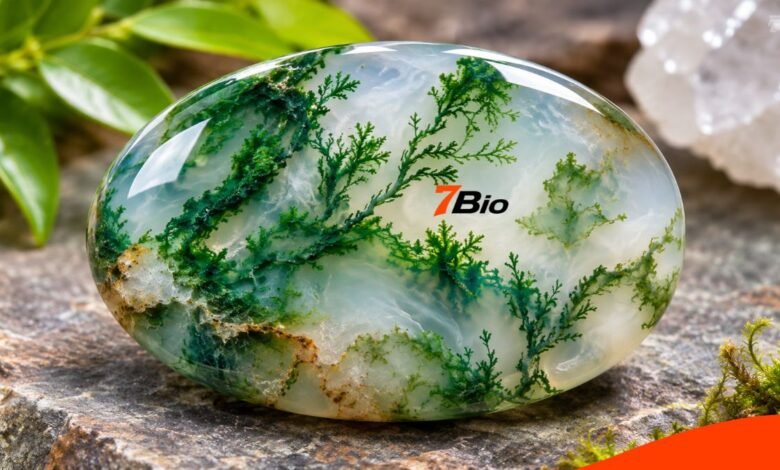
Moss Agate is a distinctive variety of chalcedony recognized for its green, branching mineral inclusions that resemble moss, leaves, and miniature forests. Unlike gemstones prized primarily for uniform color or brilliant sparkle, its appeal comes from the intricate natural patterns visible within the stone.
Part of the quartz family, this gemstone is used in jewelry, decorative objects, and mineral collections. It also carries traditional associations with growth, balance and renewal, although these symbolic meanings should not be confused with scientifically demonstrated healing properties.
Whether you are choosing a gemstone ring, examining a mineral specimen or learning about crystal traditions, understanding the stone’s formation, characteristics and care requirements can help you make an informed decision.
Quick Answer: Moss Agate is a form of microcrystalline quartz containing naturally occurring mineral inclusions. Its green, plant-like markings are inorganic structures, not real moss or fossilized vegetation.
What Is Moss Agate?
Moss Agate belongs to the chalcedony group, a fine-grained form of silica composed predominantly of microscopic quartz crystals. Its chemical composition is silicon dioxide (SiO₂).
The stone usually has a colorless, whitish, or translucent base with green inclusions. These inclusions may contain minerals such as chlorite or hornblende, while iron and manganese compounds can contribute brown, reddish or darker markings.
Traditional agate is generally associated with distinctive bands. Moss-bearing chalcedony often lacks these layers, making its familiar commercial name broader than a strict mineralogical classification.
The gemstone’s defining feature is its appearance. Some specimens contain delicate threads resembling underwater plants, while others display dense green clouds or branching formations that look like tiny woodland scenes.
Moss Agate Properties and Characteristics
Understanding its physical properties helps distinguish the gemstone from decorative glass, resin, and other mineral materials.
| Property | Details |
|---|---|
| Mineral family | Quartz |
| Variety | Chalcedony |
| Chemical composition | Silicon dioxide (SiO₂) |
| Typical colour | White, colourless, green and grey, sometimes with brown or red |
| Mohs hardness | Approximately 6.5–7 |
| Transparency | Commonly translucent |
| Defining feature | Moss-like or dendritic mineral inclusions |
| Common cuts | Cabochon, faceted, beads and polished freeform |
| Popular applications | Rings, pendants, earrings and decorative specimens |
The Mohs hardness rating indicates resistance to scratching, not immunity to physical damage. A stone can have reasonable scratch resistance while remaining vulnerable to chips or fractures following a hard impact.
That distinction matters, especially when choosing jewelry for frequent wear.
How Does Moss Agate Form Naturally?
The gemstone develops through geological processes involving silica-rich fluids and mineral deposits.
Chalcedony forms when silica is deposited within suitable spaces in rocks, including cavities and fractures. Under favorable conditions, other minerals are incorporated into the developing material or form distinctive structures within it.
The resulting patterns can spread in irregular, branching shapes. Geologists describe tree-like growth forms as dendritic, a term referring to their structure rather than their botanical origin.
Different mineral compositions produce different colors. Green material may be associated with chlorite or amphibole minerals, while iron oxides can create reddish or brown appearances.
These processes help explain why two pieces of the same gemstone may look remarkably different. The arrangement, concentration, and color of the inclusions vary between specimens.
What Does Moss Agate Look Like?
The most recognizable examples contain green markings suspended within a pale, translucent background.
Their appearance varies in several ways.
Green Moss-Like Patterns
Green is the color most strongly associated with the gemstone. The markings may resemble delicate grass, fern leaves, tree branches, or scattered vegetation.
Some specimens have sparse inclusions separated by clear areas, allowing light to reveal the pattern’s apparent depth.
White and Milky Backgrounds
Many pieces have a soft white or cloudy base rather than complete transparency.
This contrast can make darker inclusions stand out even more. More opaque material may also be marketed under overlapping names, including tree agate.
Brown, Red and Dark Inclusions
Not every specimen is predominantly green. Certain stones contain brown, reddish or black mineral patterns.
These variations reflect differences in mineral composition and should not automatically be treated as evidence of artificial coloring.
Scenic and Landscape-Like Patterns
Some cut stones display arrangements that resemble hills, forests, or natural landscapes.
Their visual character depends partly on how the lapidary positions and polishes the material. A thoughtful cut can reveal an attractive pattern that would be difficult to appreciate in an unpolished specimen.
Moss Agate Meaning and Symbolism
Historically and within contemporary crystal traditions, this gemstone has been associated with nature, growth, abundance, and emotional balance.
Its green patterns provide an obvious visual connection with plants and landscapes. That resemblance has influenced the symbolic meanings attached to it.
Growth and New Beginnings
Many crystal enthusiasts associate the stone with personal development and fresh beginnings. It is sometimes given as a symbolic gift during important life changes.
These associations express cultural or personal beliefs rather than measurable effects caused by the mineral.
Calmness and Emotional Balance
In crystal-healing traditions, the gemstone is sometimes used during meditation or reflection.
Holding a favorite stone may be part of a personally meaningful relaxation routine. However, there is no reliable scientific evidence that the mineral itself treats anxiety, depression, or other medical conditions.
Abundance and Prosperity
Some traditions connect moss-bearing agate with prosperity, particularly through its associations with healthy growth and natural abundance.
Such symbolism should not be interpreted as a guarantee of financial success or favorable life events.
The most defensible understanding is that these meanings reflect beliefs and personal significance, not scientifically proven supernatural properties.
Moss Agate Benefits: What Is Actually Supported?
The gemstone offers several practical advantages as a decorative material.
Its appearance is unusually varied, providing substantial choice for people who prefer organic patterns over uniformly coloured stones.
Its quartz-based composition also gives it useful scratch resistance for many jewelry applications when handled appropriately.
As an ornamental material, it can be shaped into beads, pendants, polished stones and decorative carvings.
The visual connection with nature may also make it meaningful to people who appreciate botanical design.
Claims that the gemstone improves immunity, heals illness, regulates hormones, or attracts money are not supported by reliable scientific evidence. Its demonstrated value lies in its mineral characteristics, appearance, craftsmanship, and personal symbolism.
Common Uses of Moss Agate
Rings and Engagement Jewelry
People often choose this gemstone for rings because its inclusions create distinctive patterns.
It can be particularly appealing to buyers looking for an alternative to conventional transparent gemstones.
For everyday wear, consider protective settings. A bezel or another design that shields vulnerable edges can help reduce exposure to accidental impacts.
Necklaces and Pendants
Pendants are a practical way to display larger botanical patterns.
Because necklaces generally take fewer direct impacts than frequently worn rings, they can suit stones with more delicate edges or prominent surface features.
Earrings and Bracelets
Smaller polished stones can be incorporated into earrings, beads, and bracelet designs.
A balanced arrangement may combine several different patterns, highlighting the natural variation rather than trying to make every piece appear identical.
Decorative Objects
Beyond jewelry, the material is used for polished display stones, carvings, and mineral collections.
Collectors may especially appreciate unusual patterns, attractive color combinations, and well-preserved natural specimens.
Moss Agate vs Tree Agate: What Is the Difference?
Both names describe closely related chalcedony materials with plant-like mineral inclusions. Their terminology can overlap, so the distinction is usually based on appearance rather than a separate mineral species.
| Feature | Moss Agate | Tree Agate |
|---|---|---|
| Typical background | Translucent, clear or milky | More opaque, often white or cream |
| Pattern | Moss-like clouds and branching inclusions | Stronger green tree-like markings |
| Visual depth | Patterns may appear suspended inside | Markings often appear against a solid background |
| Mineral family | Chalcedony | Chalcedony |
| Common use | Jewellery and decorative stones | Beads, carvings and jewellery |
These are common trade distinctions, not absolute identification rules. Intermediate specimens may reasonably be described using either name.
For buying purposes, the photographs and actual appearance are often more informative than the label alone.
How to Identify Genuine Moss Agate
Visual examination can provide useful clues, although it cannot always conclusively establish authenticity.
Examine the Internal Pattern
Look for irregular, branching mineral inclusions rather than a perfectly repeated decorative pattern.
Natural structures often vary in density, direction, and depth.
Check Translucency
Many specimens allow some light through their pale chalcedony background.
Holding a stone near a light source may reveal details that are difficult to see under ordinary room lighting.
However, opacity alone does not prove that a specimen is artificial.
Inspect for Possible Treatments
Some agates are dyed or otherwise treated.
Unusually concentrated color around fractures, artificial-looking color saturation, or suspiciously uniform decorative patterns may justify further questions.
None of these observations provides definitive proof on its own.
Avoid Damaging Tests
Scratching a gemstone against glass or metal is not a recommended home authentication method. It may damage the stone or another surface and does not reliably establish its identity.
For an expensive purchase or a disputed specimen, consult a qualified gemmologist or reputable gem-testing laboratory.
How to Choose a Good Moss Agate Stone
The most attractive gemstone isn’t necessarily the clearest or darkest. Its overall appearance and intended use matter more.
Consider these five practical steps before purchasing.
Five Buying Steps: Examine the natural pattern; assess the polish and surface; check for cracks or chips; ask about treatments and authenticity; choose a suitable cut and setting.
Good polishing can make a substantial difference. A smooth surface allows the internal patterns to be viewed clearly, while poorly finished edges may affect both appearance and comfort.
For a ring, examine the setting as carefully as the stone. A secure, well-supported mounting is particularly important for jewelry worn frequently.
Buyers should also ask whether a photograph shows the exact gemstone being supplied. Because natural inclusions differ, a representative product image may not reflect the individual stone you receive.
Is Moss Agate Expensive?
Moss Agate is generally an accessible gemstone compared with many high-value precious stones, although finished jewelry prices vary considerably.
Several factors influence what buyers pay, including pattern quality, translucency, color contrast, dimensions, artistry, and the metal used in the setting.
A carefully polished cabochon with an attractive landscape-like arrangement may appeal more to a collector than a larger specimen with indistinct markings.
For rings, the setting, precious-metal content, design complexity, and additional gemstones can account for a substantial proportion of the final price.
No universally accepted grading scale assigns a fixed value to every specimen. Buyers should compare actual stones and artistry rather than relying solely on promotional descriptions such as premium or rare.
How to Clean and Care for Moss Agate
Appropriate maintenance helps preserve the stone’s polished surface and protects its setting.
For routine cleaning, use lukewarm water with a small amount of mild soap. Wipe gently with a soft cloth or, where appropriate, use a soft brush; then rinse carefully and dry thoroughly.
Avoid aggressive scrubbing, abrasive cleaning powders, and strong household chemicals.
Steam cleaning and ultrasonic machines are generally best avoided, especially where inclusions, fractures or treatments may affect the material’s response.
Store the gemstone separately from harder jewelry pieces to minimize scratches.
Remove rings before activities involving substantial physical impact, rough surfaces, or strong cleaning products.
These precautions are particularly sensible for engagement rings and other frequently worn items.
FAQs
1. Is Moss Agate a Real Gemstone?
Yes. It is a naturally occurring chalcedony material within the quartz family. Its botanical-looking inclusions are mineral structures, not actual plant material.
2. Can Moss Agate Be Worn Every Day?
You can wear it regularly with proper care. Its hardness makes it reasonably resistant to scratches, but protective settings and sensible handling help reduce the risk of damage.
3. Does Moss Agate Have Healing Powers?
It has traditional associations with emotional balance and personal growth, but scientific evidence does not establish that wearing or holding it can treat physical or mental health conditions.
4. Why Does Moss Agate Have Green Patterns?
The green appearance usually comes from natural mineral inclusions, including chlorite or certain amphibole minerals. Their arrangements create the distinctive plant-like shapes.
5. Is Every Moss Agate Stone Unique?
Natural specimens vary in their inclusion patterns, colors, and distribution. Even stones cut from the same rough material may display noticeably different designs, although visual differences alone cannot prove authenticity.
Final Takeaway
Moss Agate is a fascinating example of how geological processes can create patterns that resemble living landscapes.
Its appeal combines natural mineral structures, distinctive visual character, and versatility in jewelry design. Understanding its quartz composition, traditional symbolism, durability, and identification limitations makes it easier to appreciate the stone without relying on unsupported claims.
For collectors and jewelry buyers alike, the most sensible approach is to prioritize an attractive natural pattern, sound craftsmanship, transparent seller information, and proper care.