Orchid Mantis: The Fascinating Flower-Like Predator Explained
Discover how this remarkable insect uses floral deception, specialized hunting abilities, and dramatic color changes to survive.

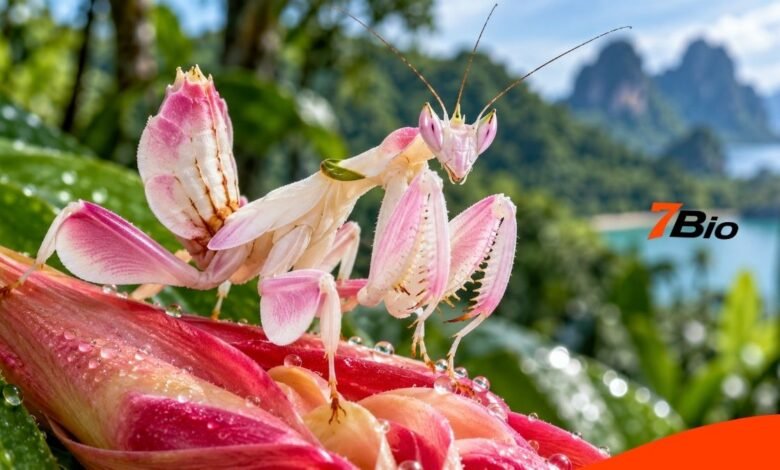
The orchid mantis (Hymenopus coronatus) is an extraordinary predatory insect recognized for its striking resemblance to a flower. With pale white or pink coloring, petal-shaped legs, and an unusual body structure, it can look more like a delicate blossom than a living hunter. Yet beneath this beautiful appearance lies a specialized predator that attracts and captures other insects.
Native to tropical Southeast Asia, this species has attracted considerable scientific interest because its appearance does more than help it blend into vegetation. Research has demonstrated that its flower-like signals can attract pollinating insects, creating opportunities to capture prey.
Perhaps most surprisingly, the insect does not need to imitate one particular orchid flower. Its unusual shape and color appear to exploit the visual signals pollinators associate with flowers.
What Is an Orchid Mantis?
The orchid mantis is a praying mantis species in the family Hymenopodidae. Its scientific name, Hymenopus coronatus, identifies a highly specialized insect whose appearance differs noticeably from the familiar green or brown mantises seen in gardens.
Like other praying mantises, it has a triangular head, prominent eyes, six legs, and specially adapted front legs used for seizing prey. Its most distinctive features are the enlarged, flattened sections of its middle and hind legs. These structures resemble flower petals and contribute to the insect’s unusual outline.
Its coloring and shape have earned it several common names, including the pink orchid mantis and walking flower mantis. These names describe its appearance rather than a botanical relationship: it is an animal, not a flowering plant.
The species is also remarkable for the substantial size difference between adult males and females, a biological characteristic known as sexual size dimorphism.
Why Does the Orchid Mantis Look Like a Flower?
The mantis’s flower-like appearance is linked to a biological phenomenon called floral mimicry. Rather than relying only on concealment, the insect possesses physical characteristics that can influence how other animals perceive it.
A pale body, broad leg expansions, and carefully positioned limbs create a visual signal that resembles flower elements. To a human observer, this may look like straightforward camouflage. For a visiting insect, however, color and visual contrast matter more than precise petal shape.
Color Plays a Crucial Role
Research published in 2014 investigated how pollinators respond to the insect’s appearance. Experiments using artificial mantis models showed that flower-like white coloring increased inspection by pollinating insects when compared with brown models.
Interestingly, altering the shape of the petal-like leg extensions did not produce the same clear effect on attraction. This suggests that the insect’s color signals may be particularly important in deceiving potential prey.
The mechanism is more sophisticated than merely looking pink to human eyes. Bees and other insects perceive light differently from humans, including ultraviolet wavelengths. A mantis that appears flower-like to us may produce a distinctive visual signal to an insect searching for nectar.
It Does Not Copy One Particular Orchid
One common misconception is that this mantis evolved to resemble a single orchid species exactly.
Research comparing the insect with flowers growing in its Malaysian habitat found no strong evidence that it copies one particular species. Instead, its appearance falls within the broader visual characteristics shared by several different flowers.
Scientists describe this possibility as generalized floral deception. The animal resembles a flower-like stimulus without necessarily matching a specific botanical model.
Where Does the Orchid Mantis Live?
The species occurs in tropical Southeast Asia, with key field studies conducted in Peninsular Malaysia. It is associated with warm, vegetated environments and the insect communities that support its hunting behavior.
Although photographs frequently show individuals sitting on orchid flowers, this should not be interpreted as evidence that the animal spends its entire life on orchids. Researchers have also described mantises occupying foliage away from flowers.
Its natural distribution and ecology are not documented equally well in every region. Because the species can be difficult to locate in the wild, some aspects of its habitat preferences remain less understood than its appearance.
The surrounding vegetation provides places to rest, hunt, and molt, while nearby flowering plants support some of the insects that may become prey.
How Does the Orchid Mantis Hunt?
The orchid mantis is an ambush predator. It generally relies on positioning, concealment, and a sudden strike rather than pursuing prey over long distances.
When a suitable insect approaches, the mantis can rapidly extend its specialized front legs. These grasping limbs, called raptorial forelegs, possess spines that help restrain captured prey.
Attracting Pollinators
One of the most important studies of the species appeared in The American Naturalist in 2014. Researchers tested the long-standing hypothesis that the mantis could attract pollinating insects through its floral appearance.
Their field experiments demonstrated that isolated mantises attracted wild pollinators and captured them. Under these conditions, the mantises attracted visitors at a higher rate than the control flowers.
This finding provided experimental evidence that the animal’s appearance can function as a hunting signal rather than camouflage alone.
This behavior is an example of aggressive mimicry, in which a predator uses deceptive traits to gain an advantage over its prey.
Can Chemical Signals Help?
Visual deception is not the only intriguing possibility.
A separate 2014 study examined interactions between juvenile mantises and the oriental honeybee (Apis cerana). Researchers identified compounds associated with honeybee chemical communication and gathered evidence that these could help attract bees.
The findings suggest that some hunting interactions may involve both visual and chemical signals. They do not establish that every individual uses chemical deception in every hunting situation.
What Does the Orchid Mantis Eat?
This species is carnivorous and feeds on other insects rather than plant material. Pollinating insects are especially important to its distinctive hunting strategy, though its diet is not limited to one prey type.
Researchers have documented interactions with bees, and other observations link the species to flying insect prey.
Its diet demonstrates an interesting contrast: an animal that looks like a flower does not feed through photosynthesis or obtain nutrition from nectar. Its flower-like resemblance creates opportunities to capture other animals.
The mantis therefore participates in local food webs as a predator of smaller insects while remaining potential prey for larger animals.
Orchid Mantis Male vs Female: Why Are They Different?
Adult females are considerably larger than adult males. This is one of the species’ most distinctive biological characteristics.
Research published in Nature Communications in 2023 reported adult females measuring about 60–65 millimeters, compared with about 25–30 millimeters for males.
| Feature | Female | Male |
|---|---|---|
| Approximate adult length | 60–65 mm | 25–30 mm |
| Body size | Considerably larger | Much smaller |
| Development | Typically undergoes more moults | Typically matures sooner |
| Adult appearance | Broad, prominent flower-like structures | Smaller and generally less conspicuous |
| Reproductive role | Produces eggs | Mates with females |
This difference is not simply an unusual visual characteristic. Research suggests that predatory ecology and reproductive demands have shaped the evolution of female and male body sizes.
Larger females can exploit different hunting opportunities, while smaller males have different mobility and reproductive requirements.
This extreme difference also means photographs of two members of the same species may look surprisingly dissimilar.
The Remarkable Life Cycle and Color Changes
One of the most fascinating aspects of the orchid mantis is how dramatically its appearance changes during development.
Like other mantises, it undergoes incomplete metamorphosis. Young individuals hatch as nymphs and grow through a series of molts, shedding their outer skeleton as their bodies develop.
Newly Hatched Nymphs Look Different
Newly hatched individuals do not immediately have the familiar pale appearance of older mantises.
Instead, first-instar nymphs have a striking black-and-red color pattern. After their first molt, they undergo a major transition toward the pale, flower-like appearance seen in later stages.
This transformation reflects changing survival strategies as the insect develops.
What Scientists Discovered in 2025
A 2025 study published in Nature Ecology & Evolution identified an important biological mechanism behind this color transition.
The researchers described a specialized pigment transporter called Redboy, which helps regulate pigmentation changes during the first molt.
The transition involves removing particular red pigments while accumulating white pigmentation in the insect’s outer tissues.
The study also connected these changes with ecological functions. The distinctive appearance of very young nymphs helps them avoid predators, while the pale coloring of older nymphs can help both avoid predators and attract prey.
This discovery provides a deeper explanation of how genetics, hormones, and visual appearance interact during development.
Reproduction and Molting
After mating, female mantises produce eggs enclosed within a protective structure called an ootheca, or egg case.
The young eventually hatch and begin the growth stages that lead to adulthood.
Molting is especially important because insects must shed their exoskeleton to grow. The newly emerged body is initially vulnerable while the replacement exoskeleton hardens.
The final molt marks the transition into adulthood, when the insect reaches its mature form.
Can an Orchid Mantis Be Kept as a Pet?
Some specialist invertebrate enthusiasts keep orchid mantises in captivity. However, their delicate development and environmental needs make them more demanding than their beautiful appearance suggests.
Maintaining suitable warmth, moisture and ventilation is important. The enclosure must also provide enough unobstructed vertical space for the insect to hang securely during a molt.
Poorly managed conditions can cause developmental problems, especially if the animal lacks enough space or remains in excessively damp, stagnant surroundings.
Feeding also requires planning because these animals depend on appropriately sized insect prey. Young nymphs and mature females have very different body sizes, so their needs cannot be treated as identical.
Prospective keepers should seek species-specific guidance from experienced invertebrate specialists, obtain legally sourced captive-bred individuals where available, and check applicable import and ownership rules.
The species should never be released into an environment where it does not naturally occur.
Why Is the Orchid Mantis Important to Science?
This insect is especially valuable for understanding the relationship between evolution, visual perception, and predator–prey interactions.
Its flower-like appearance raises questions about how natural selection shapes physical characteristics and how different animals interpret visual information.
The species has contributed to research in several important areas.
Floral deception: Experiments show that a predator can attract flower-visiting insects with signals that resemble flowers.
Sexual size dimorphism: The dramatic differences between males and females help scientists investigate how ecological pressures influence body size and development.
Developmental genetics: Recent research into color transitions has identified a molecular mechanism linking pigmentation to different stages of an insect’s life.
Together, these findings demonstrate that the species is much more than an unusually beautiful insect. It offers a useful biological example of how appearance can influence survival, hunting and reproduction.
Common Misconceptions About the Orchid Mantis
Despite its widespread popularity in wildlife photographs and videos, several ideas about this insect deserve clarification.
One is that it must sit inside an orchid flower to hunt. Research showing attraction to isolated mantises indicates this isn’t necessary.
Another is that it perfectly mimics a particular orchid species. Available research instead supports a broader resemblance to floral signals.
A third misconception is that every individual looks pink and white throughout life. The striking black-and-red appearance of newly hatched nymphs shows that its coloring changes with development.
Finally, photographs cannot always establish an individual insect’s exact size, age, or sex. Scientific identification should consider multiple anatomical characteristics rather than color alone.
Final Takeaway
The orchid mantis is an exceptional example of how evolution can produce physical appearances that serve several biological purposes.
Its pale coloring and distinctive leg structures create a remarkable resemblance to a flower, but its biology is even more interesting than its appearance. Scientific experiments have shown it can attract pollinating insects as prey, while modern genetic research is beginning to explain how its dramatic color changes develop.
Understanding this species means looking beyond its beautiful photographs to the interactions between predator behavior, insect vision, growth, and natural selection.
FAQs
1. Is the orchid mantis dangerous to humans?
It is not generally considered dangerous to humans. Like other praying mantises, it can defend itself if disturbed, but it is not equipped with a venomous sting. Unnecessary handling should be avoided.
2. Can an orchid mantis fly?
Adults develop wings, but males and females differ in their ability to fly. The much smaller males are generally more mobile, while the larger females have different physical limitations.
3. Is the orchid mantis a real flower?
No. It is a living predatory insect with six legs, a head, wings in adulthood, and specialized grasping forelegs. Its resemblance to a flower results from biological adaptations.
4. Why are baby orchid mantises black and red?
Newly hatched nymphs display black-and-red coloring to avoid predators. Research published in 2025 identified a pigment-transport mechanism that contributes to the transition to pale coloring after the first molt.
5. Does the orchid mantis only eat bees?
No. Bees are among the prey documented in scientific studies, but the species is not restricted to one insect group. It is a carnivorous predator that can capture suitable insect prey.