GMHIW: The Good and Bad of Nasdaq Warrants and Luminar’s Merger History
Discover the history of Gores Metropoulos warrants, the Luminar Technologies merger, and why this financial symbol is no longer active.

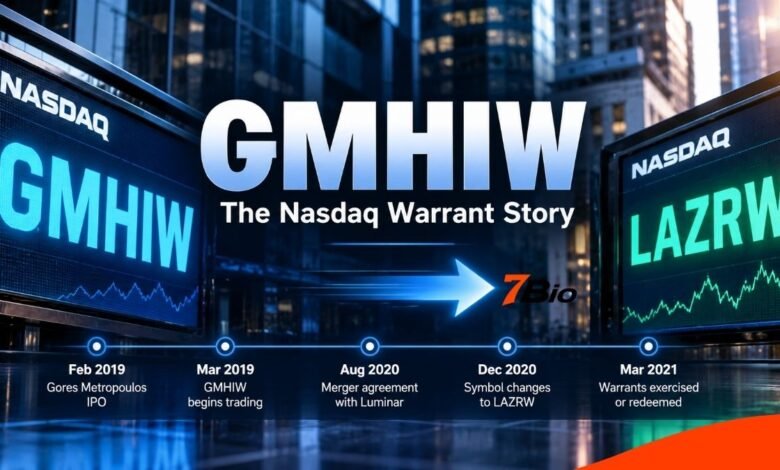
GMHIW was the Nasdaq trading symbol for publicly traded warrants issued by Gores Metropoulos, Inc., a special purpose acquisition company (SPAC). The symbol entered financial history when Gores Metropoulos completed its merger with automotive technology company Luminar Technologies in December 2020.
Although the unusual combination of letters can look like an abbreviation for a modern business concept or technology platform, its documented financial meaning is straightforward: it identified a specific type of security rather than a company, investment strategy, or independently established brand.
Following the merger, the warrant symbol changed to LAZRW. Investors subsequently exercised or redeemed those public warrants in 2021, making the original ticker a historical reference rather than an active trading opportunity.
This article explains GMHIW’s original purpose, its connection to Luminar Technologies, the warrant redemption process, and its relevance to historical financial records.
What Was GMHIW?
GMHIW was the ticker symbol for public warrants of Gores Metropoulos, Inc., a company formed to pursue a business combination.
Gores Metropoulos operated as a SPAC, sometimes called a blank-cheque company. Unlike a traditional operating company, a SPAC typically raises capital through an initial public offering before identifying and completing a qualifying acquisition or merger.
Investors could encounter different securities associated with Gores Metropoulos. Its ordinary Class A shares traded under GMHI, while the separately traded public warrants used GMHIW.
This distinction matters because a warrant is not the same financial instrument as a share. It provides contractual rights that depend on specific conditions rather than immediate ownership of the underlying stock.
The Origins of Gores Metropoulos
Gores Metropoulos was established through a partnership involving affiliates of The Gores Group and Metropoulos & Co.
The company completed its initial public offering in February 2019, issuing 40 million units. Each public unit originally included one Class A common share and one-third of a public warrant.
Beginning on March 25, 2019, investors could separately trade the shares and warrants contained in those units.
Three identifiers represented the securities:
| Symbol | Security |
|---|---|
| GMHI | Class A common stock |
| GMHIW | Public warrants |
| GMHIU | Units containing shares and fractional warrant interests |
These symbols helped distinguish ownership interests from contractual rights to acquire shares.
The separate trading arrangement was typical of SPAC structures during that period, when companies increasingly used business combinations as an alternative route to public markets.
How GMHIW Became Connected to Luminar Technologies
Luminar Technologies developed lidar technology for vehicle applications. Lidar, short for light detection and ranging, uses laser-based measurements to map the surrounding environment.
In August 2020, Gores Metropoulos entered into a merger agreement involving Luminar Technologies.
The business combination was completed on December 2, 2020. The transaction brought Luminar public through the existing SPAC structure.
Nasdaq announced changes to the securities associated with the company, effective December 3, 2020.
The original GMHI common-stock symbol became LAZR, while the GMHIW warrant symbol became LAZRW.
The change represented a corporate transition rather than the creation of an unrelated security or investment platform.
Understanding How the Public Warrants Worked
A stock warrant gives its holder the contractual right to purchase shares at an agreed exercise price, subject to applicable terms and deadlines.
The public warrants associated with Gores Metropoulos, and later Luminar, carried an exercise price of $11.50 per share.
For example, exercising an eligible warrant under those terms required paying the specified exercise price to receive the underlying share.
However, owning a warrant did not guarantee a profit. Its economic value depended on several factors, including the underlying share price, redemption provisions, and the remaining opportunity to exercise.
A warrant could lose its value if the contractual conditions became unfavorable or if the holder failed to exercise within the permitted period.
These characteristics explain why warrants and ordinary shares can perform differently, even when connected to the same company.
What Happened to the Warrants in 2021?
The successor warrants did not remain publicly traded indefinitely.
On February 3, 2021, Luminar announced plans to redeem its outstanding public warrants. The initial exercise deadline was March 5, 2021.
The company later extended the redemption deadline to March 16, 2021, giving eligible holders more time to complete the exercise process.
Public warrant trading on Nasdaq ended on March 5, 2021, while the extended exercise arrangements remained relevant to qualifying holders.
According to Luminar’s financial disclosures, 13,128,671 public warrants had been exercised by March 16, 2021. The remaining 204,638 public warrants were redeemed at $0.01 each.
By March 31, 2021, the company reported no public warrants outstanding.
This detail is particularly significant for anyone researching historical investment records. Although the successor security originally had a later scheduled expiration date, the public warrant exercise and redemption process actually occurred years earlier.
GMHIW Timeline: Important Dates
| Date | Event |
|---|---|
| February 2019 | Gores Metropoulos completed its public offering |
| 25 March 2019 | Separate trading began for GMHI shares and GMHIW warrants |
| August 2020 | Merger agreement involving Luminar Technologies |
| 2 December 2020 | Business combination completed |
| 3 December 2020 | GMHIW changed to LAZRW |
| March 2021 | Public warrants were exercised or redeemed |
| April 2026 | Luminar’s Chapter 11 liquidation plan was confirmed |
The timeline shows why readers should distinguish the former warrant symbol from Luminar’s later corporate history.
What Happened to Luminar Technologies Afterward?
The story did not end with the 2020 business combination.
After becoming publicly traded, Luminar continued its work in automotive sensing technology. However, its financial circumstances changed considerably in the years that followed.
In December 2025, Luminar Technologies and certain subsidiaries filed for Chapter 11 bankruptcy protection in the United States.
On April 3, 2026, a bankruptcy court confirmed an amended liquidation plan to wind down the debtors’ businesses in an orderly manner and administer remaining assets.
An April 2026 regulatory filing stated that holders of equity interests in the company would receive no recovery under the confirmed plan.
This development concerns Luminar’s later corporate and equity situation. It should not be confused with the original GMHIW public warrants, which had already been exercised and redeemed in March 2021.
Why Does GMHIW Still Appear in Search Results?
Historical financial identifiers can remain searchable for many years after the securities they describe stop trading.
The term may still appear in archived brokerage statements, regulatory filings, corporate-action notices, and historical financial databases.
Researchers studying the rise of SPAC transactions may also encounter the symbol when examining how private technology businesses entered public markets.
Another source of confusion is online content that treats unfamiliar ticker symbols as general-purpose abbreviations.
Some websites attach speculative meanings to these letters without demonstrating a connection to official financial records.
For accurate historical research, the relevant meaning is the Nasdaq warrant identifier associated with Gores Metropoulos.
How to Research an Old GMHIW Investment Record
Anyone who finds the symbol in an old portfolio should first confirm which security the record represents.
A practical approach is to examine the original statement date, security description, quantity, and identifying number. These details can help distinguish common shares, units and warrants.
Next, review the December 2020 corporate-action changes and the March 2021 warrant redemption events.
Investors should also check whether a historical account reflects a completed warrant exercise, cash redemption, sale, or another transaction.
Where account records are incomplete, the relevant brokerage firm or transfer agent may be able to provide documentation.
Historical transaction records are particularly important for tax reporting, estate administration and portfolio reconciliation. The appropriate treatment depends on the investor’s circumstances and jurisdiction.
Common Misunderstandings About the Ticker
One frequent mistake is treating GMHIW as an ordinary share symbol. It identified warrants, which involved different rights and risks.
Another is assuming the December 2020 ticker change meant the same symbol would continue trading indefinitely. In reality, the public warrants were subsequently exercised or redeemed.
Readers may also confuse the warrant’s originally scheduled expiry with the earlier redemption.
Finally, the symbol should not be interpreted as proof of a currently operating investment service or available security simply because it appears on a modern website.
Understanding these distinctions makes historical market information easier to interpret.
FAQs
1. What does GMHIW mean?
GMHIW was the Nasdaq trading symbol for public warrants issued by Gores Metropoulos, Inc. It was a securities identifier, not a widely established general-purpose acronym.
2. Was GMHIW a stock or a warrant?
It was a warrant. Gores Metropoulos common shares traded under GMHI, while the public warrants were identified by GMHIW.
3. What happened to GMHIW after the Luminar merger?
After the merger, the symbol changed to LAZRW, effective December 3, 2020.
4. Can GMHIW still be traded in 2026?
No. The original symbol was replaced in 2020, and investors exercised or redeemed the successor public warrants in March 2021.
5. Why is GMHIW connected to Luminar Technologies?
Gores Metropoulos completed a business combination with Luminar Technologies in December 2020. The corporate transaction changed the associated Nasdaq trading symbols.
Final Takeaway
GMHIW is best understood as a historical financial-market identifier connected to Gores Metropoulos and its merger with Luminar Technologies.
Its story provides a useful example of how SPAC securities can change during mergers and how warrants differ from ordinary shares.
The original ticker became LAZRW in December 2020, and the related public warrants were exercised or redeemed in March 2021.
For readers reviewing older statements or financial documents, recognizing this sequence is more useful than treating the term as an unexplained modern acronym.