Ensora: Powerful Healthcare Software, Features, Benefits and Pricing Guide
Learn about Ensora Health, its electronic health records, therapy practice management tools, AI capabilities, and key considerations for healthcare professionals.

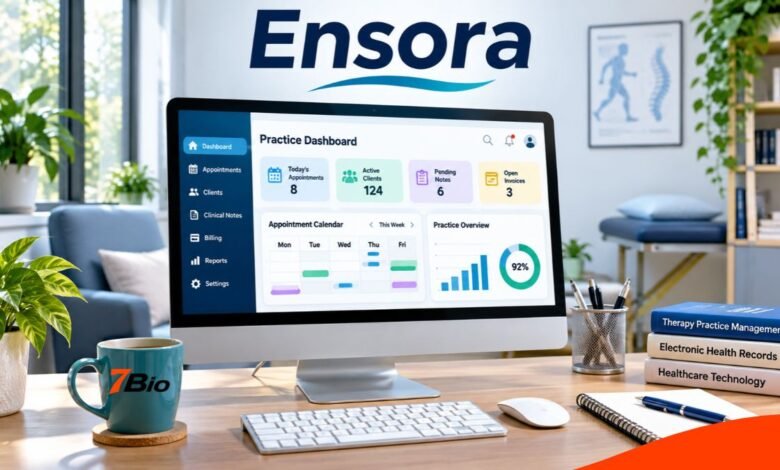
Ensora is increasingly recognized in healthcare technology through Ensora Health, a software company offering electronic health records (EHR), practice management, and administrative services for therapy professionals. The company serves mental health, behavioral health, and rehabilitation practices, helping clinicians manage documentation, appointments, billing, and other operational responsibilities.
Previously known as Therapy Brands, Ensora Health adopted its current identity in April 2025. Its products include TheraNest for mental and behavioral health professionals and Fusion for physical, occupational, and speech therapy practices.
The company’s approach combines established healthcare software with artificial intelligence tools intended to reduce repetitive administrative work. However, practices have different requirements, and understanding each product’s capabilities, pricing, and limitations is essential before choosing a system.
This guide explains what Ensora Health offers, how its products work, where AI fits into clinical workflows, and what organizations should consider before adopting the software.
What Is Ensora?
Ensora Health is a healthcare technology provider specializing in software and services for therapy practices. Its central purpose is to support the operational side of delivering care, allowing professionals to manage clinical and administrative responsibilities within dedicated digital systems.
The company offers tools covering patient documentation, scheduling, insurance claims, payments, telehealth and revenue cycle management.
Unlike general-purpose business management applications, its main products are designed around healthcare professionals’ workflows.
How Ensora Health Developed
The organization operated under the name Therapy Brands before announcing its rebranding to Ensora Health on 7 April 2025.
The name reflects the company’s emphasis on collaboration between therapists, clients and other participants in healthcare delivery. According to the company, it combines an idea associated with an ensemble with the Japanese word sora, meaning sky.
Following the rebrand, Ensora Health introduced a broader platform strategy intended to connect clinical documentation, financial administration and practice management services.
The company reports serving more than 200,000 individual providers and 28,000 practices. These figures are company-reported usage measures, not independently verified assessments of customer satisfaction.
How Does Ensora Work?
Ensora Health operates through specialized software products rather than a single identical application for every healthcare discipline.
A therapy practice chooses a product that matches its work, establishes client records, configures scheduling and documentation procedures, and enables the billing or other services included in its subscription.
Managing Appointments and Client Records
Scheduling and record management are fundamental components of therapy practice software.
Clinicians and administrative staff need reliable ways to arrange appointments, document attendance, and locate relevant client information.
With an appropriate Ensora product, these activities can be organized within the practice’s digital environment. This reduces dependence on separate spreadsheets, paper-based records and disconnected administrative processes.
Specific scheduling, portal, and communication capabilities depend on the product and subscription tier.
Clinical Documentation
Clinical notes are essential to continuity of care, communication and professional recordkeeping.
Ensora’s EHR products support documentation workflows suited to different therapy types. Mental health professionals may need progress notes and treatment documentation, while rehabilitation practitioners may require functional assessments, therapy goals, and structured progress tracking.
The distinction matters because documentation needs differ across clinical disciplines.
Billing and Practice Administration
Therapy practices must also manage payments, insurance claims, and financial records.
Ensora provides billing-related functionality through its products and additional services. Some practices may use built-in tools to administer claims themselves, while others may consider revenue cycle management support.
The appropriate arrangement depends on a practice’s size, payer relationships, staffing, and billing requirements.
Key Products and Services Offered by Ensora
Two products are central to Ensora Health’s current offering.
TheraNest: Software for Mental and Behavioral Health
TheraNest is designed for mental health and behavioral health professionals.
Its capabilities include appointment scheduling, clinical documentation, client records, and payment management. Depending on the subscription, practices can also access insurance billing features, client communications, and telehealth.
The software suits independent therapists and group practices that need a system built around mental healthcare workflows.
Fusion: Software for Rehabilitation Practices
Fusion focuses on rehabilitation therapy, including speech-language pathology, occupational therapy, and physical therapy.
It supports clinical documentation, scheduling, billing, and coordinated records for professionals working across these disciplines.
The distinction is particularly relevant for multidisciplinary practices. A shared client may receive several types of therapy, making consistent records and coordinated workflows valuable.
In July 2026, Ensora announced additional Fusion functionality aimed at adult physical therapy, including protocol-driven documentation and reporting capabilities.
Additional Ensora Services
The broader product portfolio also includes revenue cycle management, telehealth, payment processing, clearinghouse services, and electronic prescribing.
These services are not necessarily included in every subscription. Practices should confirm whether they are available for their chosen product, whether additional charges apply, and what implementation requirements exist.
Ensora AI: What Is Ensai?
An important development within Ensora Health is Ensai, the company’s AI technology integrated into its primary EHR products.
Introduced under the Ensai name in July 2026, it is intended to assist with clinical documentation and routine software-related tasks, not replace professional decision-making.
Ensai Session Assistant
Ensai Session Assistant can use a recorded therapy session, with the required consent, to prepare draft documentation.
The clinician remains responsible for checking the information, correcting inaccuracies, and signing the final record.
This distinction is significant. An AI-generated document is not automatically an accurate clinical record, regardless of how convincingly it is written.
Ensai Notes Enhancement
Notes Enhancement works with documentation a clinician has already written.
Rather than recording the session, it helps refine existing text. The professional must still verify that the resulting note accurately describes the encounter.
As of November 2026, this functionality was established in TheraNest, while Ensora had announced further availability and enhancements for Fusion.
Ensai Support
Ensai Support is designed to answer routine questions about using the software.
For example, a staff member may need help understanding a particular workflow or locating product guidance. The assistant draws on product documentation rather than using clinical records to answer such questions.
This separates everyday software assistance from clinical decision-making.
Ensora Pricing: How Much Does It Cost?
Ensora Health publishes pricing for its main products, although subscription costs vary by product, plan, and practice size.
The following figures reflect advertised US-dollar pricing reviewed in November 2026.
| Product | Published starting pricing | Main purpose |
|---|---|---|
| TheraNest Essentials | $29 per therapist/month | Core mental health practice management |
| TheraNest Advanced | $59 per therapist/month | Additional billing and administrative tools |
| TheraNest Premier | $89 per therapist/month | More extensive insurance billing capabilities |
| Fusion | From $25/month for eligible solo practices | Rehabilitation therapy management |
| Ensora RCM | Custom quotation | Revenue cycle management services |
For multi-clinician Fusion practices, Ensora also advertises plans priced at $159 or $229 per month for the first user, with additional-user charges depending on the chosen plan.
These are published rates, not a personalized quotation. Optional AI tools, payment processing, implementation arrangements and other services can affect the total cost.
Before subscribing, practices should compare their likely monthly expenditure rather than focusing only on the advertised entry-level price.
Benefits of Using Ensora Health
The most relevant potential benefit is administrative consolidation.
Instead of maintaining unrelated systems for appointments, documentation, and billing, a practice may be able to manage several responsibilities through a more connected workflow.
Another advantage is clinical specialization. Mental health professionals and rehabilitation clinicians do not require the same records or processes. Ensora’s separate products recognize those differences.
AI-assisted documentation may also reduce time spent preparing notes, although the actual savings depend on the individual clinician, documentation requirements and how much correction the generated text needs.
For growing organizations, reporting, coordinated records and administrative services can support more structured operations.
These are potential operational advantages, not guaranteed improvements in treatment outcomes, profitability, or staff productivity.
Limitations and Considerations
Not every practice will find the same value in Ensora’s products.
Subscription and Additional Costs
A lower starting price does not necessarily represent the complete cost of running a practice.
Billing features, AI assistance, transaction charges, telehealth, and additional users may affect expenditure. Organizations should compare the complete package against their actual requirements.
Training and Workflow Changes
Switching an EHR system involves more than purchasing software.
Staff may need training, existing records may require migration, and internal procedures may need adjustment. These changes can temporarily increase administrative workloads.
Before moving sensitive records, practices should confirm what import and export capabilities are available and how data integrity will be checked.
AI Accuracy and Human Oversight
AI-generated notes can contain omissions, incorrect details, or misleading interpretations.
Clinicians should maintain responsibility for clinical accuracy, appropriate language, and compliance with professional documentation requirements.
No automated writing tool should be treated as an independent clinical authority.
Is Ensora Secure for Healthcare Information?
Healthcare information requires strong privacy and security protections.
Ensora Health describes an information security program involving encryption, access controls, monitoring, risk management, and policies informed by healthcare privacy requirements.
Its published responsible AI policy states that identifiable client protected health information is not used to train AI models. The policy separately addresses permitted uses of de-identified and other non-identifiable data.
These are important commitments, but they do not eliminate a practice’s responsibility to evaluate contractual terms, security arrangements, consent procedures and applicable regulations.
For session-recording features, informed consent and appropriate professional oversight are particularly important.
Considerations for UK Healthcare Practices
Much of Ensora Health’s published pricing and compliance information is oriented towards the United States.
UK healthcare providers should establish whether a particular product is available and suitable for their jurisdiction before adopting it.
They should also assess UK GDPR responsibilities, health data protections, international data transfers, contractual safeguards, and any relevant professional or healthcare-sector requirements.
Compliance with US healthcare regulations should not automatically be interpreted as proof of compliance with every UK requirement.
Recent Ensora Developments in 2026
Ensora Health continued expanding its therapy-focused technology during 2026.
In July, it announced the Ensai AI product across five therapy disciplines: mental health, behavioral health, speech-language pathology, physical therapy and occupational therapy.
The company also expanded Fusion’s capabilities for adult physical therapy.
On 10 November 2026, Ensora outlined further investment in Fusion, including planned AI documentation enhancements and additional credentialing support.
The announcement also described support for payer enrolment and further development of workflows shared across rehabilitation disciplines.
These developments indicate the company’s continuing emphasis on combining clinical records with administrative services. Announced future functionality should not, however, be treated as available until its release is confirmed.
How to Decide Whether Ensora Is Right for Your Practice
Selecting healthcare software should start with the organization’s needs, not the length of a product’s feature list.
A practical evaluation can follow these steps:
- Identify clinical requirements: Determine which disciplines, documentation formats, and treatment workflows the software must support.
- Review administrative needs: Examine scheduling, payments, insurance billing, reporting and communication requirements.
- Calculate total costs: Include subscriptions, additional users, optional services, and applicable transaction fees.
- Assess data protection: Review security documentation, contracts, data transfers, consent procedures, and legal obligations.
- Request a demonstration: Ask the provider to show realistic workflows that reflect the practice’s everyday work.
- Evaluate migration and support: Confirm how existing data can be transferred, how staff will be trained, and what happens if the practice later changes systems.
A useful demonstration should show the complete journey from registering a client to producing clinical documentation and finalizing the appropriate billing process.
That offers more practical evidence than a presentation focused only on attractive interface features.
FAQs
1. What is Ensora Health used for?
Ensora Health provides electronic health records, therapy practice management software, and related administrative services. Its products help healthcare professionals organize appointments, clinical documentation, billing, and practice operations.
2. Is Ensora the same as Therapy Brands?
Ensora Health is the name Therapy Brands adopted in April 2025. The rebranding reflected a broader strategy centered on connected therapy software and services.
3. Does Ensora offer AI tools?
Yes. Ensora provides Ensai, which includes AI-assisted session documentation, note enhancement, and product support functionality. Availability and pricing vary by product and feature.
4. Can a small therapy practice use Ensora?
Yes. TheraNest includes subscription options intended for individual therapists and smaller practices. Fusion also advertises options for solo rehabilitation practices. Suitability depends on the practitioner’s discipline and requirements.
5. Is Ensora Health available in the UK?
The company publishes information primarily oriented towards US healthcare practices. UK organizations should confirm product availability, local suitability, applicable data protection obligations, and contractual arrangements directly with the provider.
6. Is Ensora free to use?
Ensora Health’s principal EHR products are paid services. Certain trials or included features may be offered, but the availability of free trials, optional AI capabilities and subscription terms should be checked before registration.
Final Takeaway
Ensora represents a specialized approach to healthcare software through Ensora Health’s combination of electronic health records, practice management, billing services, and AI-assisted tools.
Its principal products, TheraNest and Fusion, address different clinical disciplines while sharing a broader focus on making practice administration easier to manage.
The introduction of Ensai adds further documentation and software-assistance capabilities, but professional review, data privacy and responsible implementation remain essential.
For healthcare organizations considering Ensora Health, the most useful decision is not whether the platform offers the most features. It is whether the selected product supports the practice’s specific clinical workflows, financial requirements, and data protection responsibilities at a sustainable cost.