
Community Titles Scheme: 7 Important Benefits and Risks You Should Know
Understand shared property ownership, body corporate responsibilities, legal requirements and the financial commitments involved in buying a community title property in Australia.

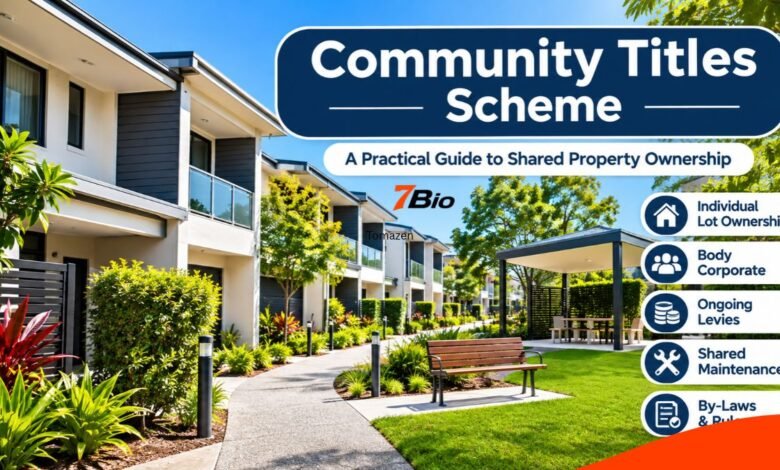
A community titles scheme is a property ownership arrangement that allows individuals to own separate lots within a development while sharing responsibility for communal areas and facilities. Commonly associated with apartments, townhouses, and residential estates in Australia, this structure provides a legal framework for managing shared property, maintenance expenses, and community rules.
For prospective buyers, understanding this arrangement is just as important as evaluating the property itself. Purchasing a home within a scheme can bring ongoing financial obligations, collective decision-making responsibilities, and restrictions on certain property improvements.
This guide focuses primarily on Queensland’s community titles system, explaining how ownership works, what the body corporate does, how fees are set, and which documents buyers should review before purchasing.
What Is a Community Titles Scheme?
A community titles scheme (CTS) is a legally recognized arrangement involving individually owned property lots and common property, governed by registered documentation.
In Queensland, the Body Corporate and Community Management Act 1997, together with applicable regulations, primarily regulates these arrangements.
An individual lot may consist of an apartment, townhouse, commercial premises or another form of property. Common property may include shared driveways, gardens, staircases, corridors and recreational facilities, depending on the development’s registered boundaries.
Unlike conventional standalone property ownership, community title ownership involves both individual property rights and collective obligations. Owners participate in managing their development through a body corporate.
The precise legal structure varies across Australian states, meaning Queensland’s requirements should not automatically be applied to properties elsewhere.
How Does a Community Titles Scheme Work?
When someone purchases a lot within a Queensland community titles development, they automatically become a member of the body corporate. Membership is attached to property ownership rather than being an optional arrangement.
Owners retain legal ownership of their individual lots while contributing towards the management and maintenance of shared areas. Decisions concerning communal expenses, repairs and improvements are made through the body corporate in accordance with applicable legislation.
For example, consider a residential development with 12 townhouses, a shared driveway, a landscaped entrance, and visitor parking. Each homeowner owns their respective lot, while the management of shared facilities is handled collectively.
This arrangement allows residents to benefit from communal infrastructure without requiring one homeowner to manage the entire development independently.
Understanding the Role of the Body Corporate
The body corporate is the legal entity responsible for administering common property and managing lot owners’ collective interests.
Its principal responsibilities generally include:
- Maintaining common property and shared facilities.
- Managing budgets and collecting owner contributions.
- Arranging legally required insurance.
- Administering community by-laws.
- Organizing meetings and maintaining records.
- Making decisions about repairs and improvements.
Some developments appoint a professional body corporate manager to assist with administrative responsibilities. However, the manager’s authority depends on their appointment and the applicable legislation.
Owners can participate in collective decisions through meetings and voting arrangements, subject to relevant legal requirements.
What Is a Community Management Statement?
The Community Management Statement (CMS) is an essential registered document within Queensland’s community titles system.
It contains important information about the development’s governance, including applicable by-laws, lot entitlement schedules and the relevant regulation module.
Prospective buyers should review this document because it helps establish their rights and obligations as future owners.
Understanding Lot Entitlements
Queensland community titles schemes generally have two lot entitlement schedules.
The contribution schedule helps determine owners’ financial contributions and certain voting rights. The interest schedule relates to ownership interests in common property, certain expenses and other property-related calculations.
These entitlements mean that homeowners within the same development do not necessarily pay identical amounts towards communal expenses.
Understanding the schedules before purchasing helps buyers assess their ongoing financial responsibilities.
Community Titles Scheme Fees and Financial Responsibilities
Owners contribute towards expenses associated with operating and maintaining the development. These payments are commonly called body corporate levies.
Most Queensland schemes operate with an administrative fund and a sinking fund, although specified two-lot schemes have different financial management requirements.
Type of contribution
Main purpose
Administrative fund Routine maintenance and operating expenses
Sinking fund Future major repairs and asset replacement
Special contribution Additional expenses not adequately covered by existing budgets
The amount payable depends on the development’s financial requirements, facilities, maintenance needs and applicable contribution arrangements.
A development with lifts, extensive gardens and other shared facilities may have different operating expenses from a small townhouse complex.
Buyers should examine the property’s financial records rather than relying exclusively on its current advertised fees.
Community Title vs Traditional Property Ownership
Community title ownership differs from owning a standalone property outside a shared ownership scheme.
| Feature | Community title | Standalone property outside a scheme |
|---|---|---|
| Ownership | Individual lot and shared property interests | Individually owned property |
| Management | Body corporate | Property owner |
| Maintenance | Individual and collective responsibilities | Primarily the property owner |
| Ongoing levies | Generally applicable | No body corporate levies |
| Property modifications | May require additional approvals | Subject to applicable planning and legal requirements |
| Shared facilities | May be available | Generally privately managed |
Neither arrangement is automatically better. The appropriate choice depends on a buyer’s budget, lifestyle preferences and willingness to participate in collective property management.
Is Community Title the Same as Strata Title?
Community title and strata title are closely related concepts, but their legal meanings depend on the Australian state in which the property is located.
In Queensland, community titles legislation covers many developments commonly described as strata properties.
South Australia distinguishes between community schemes and community strata schemes. Western Australia introduced community schemes under the Community Titles Act 2018, which operates alongside its existing strata legislation.
Consequently, buyers should identify the property’s jurisdiction and registered ownership structure before comparing their legal obligations.
Benefits of a Community Titles Scheme
Shared Maintenance Responsibilities
Owners can collectively arrange maintenance for communal infrastructure. This can reduce the administrative burden of managing shared driveways, gardens and other facilities individually.
Access to Shared Facilities
Depending on the development, residents may benefit from landscaped spaces, recreational areas, visitor parking and other communal amenities.
Established Management Arrangements
Registered by-laws, financial procedures and collective decision-making arrangements provide a framework for managing the development and addressing community-related concerns.
Participation in Property Management
Property owners can contribute to decisions concerning budgets, maintenance priorities and proposed improvements through applicable body corporate procedures.
Potential Disadvantages and Risks
Community title ownership also involves responsibilities that prospective buyers should consider carefully.
Regular levies increase the ongoing costs of property ownership. Unexpected repairs or insufficient financial reserves may result in additional contributions.
Owners may also need approval before undertaking certain renovations, modifying common property or installing external equipment.
Disagreements can arise over maintenance responsibilities, parking arrangements, noise and expenditure decisions.
Another important consideration is the development’s financial condition. Relatively low levies may appear attractive, but buyers should investigate whether adequate provision has been made for future repairs.
What Should Buyers Check Before Purchasing?
A property inspection alone cannot establish whether a community titles development is financially or administratively well managed.
Queensland’s seller disclosure scheme commenced on August 1, 2025, and introduced updated disclosure requirements under the Property Law Act 2023. For applicable community title property sales, relevant documents generally include a seller disclosure statement, community management statement and body corporate certificate, subject to statutory exceptions.
Prospective buyers should consider reviewing the following information.
| Document or information | Why it matters |
|---|---|
| Registered survey plan | Identifies lot and common property boundaries |
| Community management statement | Explains governance arrangements and by-laws |
| Body corporate certificate | Provides relevant ownership and financial information |
| Financial statements | Helps assess the scheme’s financial position |
| Meeting minutes | May reveal proposed expenditure and ongoing concerns |
| Insurance documentation | Identifies existing coverage |
| Maintenance records | Helps identify potential future repair costs |
An independent property solicitor or suitably qualified conveyancer can help interpret these documents before a buyer enters into a binding agreement.
Maintenance and Property Improvement Rules
Maintenance responsibilities depend on the registered survey plan, property boundaries, regulation module and relevant legal provisions.
The body corporate generally maintains common property, while individual owners usually maintain their own lots. However, exceptions can arise involving utility infrastructure, building elements and exclusive-use areas.
For instance, an area used exclusively by one resident may still legally form part of common property.
Owners considering structural alterations, external installations or changes affecting communal areas should confirm whether approval is required before commencing work.
How Are Community Title Disputes Resolved?
Queensland provides established procedures for resolving eligible body corporate disputes.
Affected parties must generally attempt to resolve the disagreement internally before pursuing formal dispute resolution.
Where those efforts are unsuccessful, conciliation or adjudication through the Office of the Commissioner for Body Corporate and Community Management may be available.
Keeping written correspondence, meeting records and relevant documentation can help clarify the circumstances surrounding a dispute. Complex legal matters may require independent professional advice.
FAQs
1. Is membership of a community titles scheme compulsory?
In Queensland, purchasing a lot within a registered community titles scheme automatically makes the owner a member of its body corporate.
2. Can I sell a community title property?
Yes. Owners can generally sell their individual lots, subject to applicable property laws, contractual requirements and seller disclosure obligations.
3. Can a community titles scheme have only two properties?
Yes. Queensland recognizes schemes containing two lots, and eligible developments may operate under the Specified Two-lot Schemes Module.
4. Can body corporate fees increase?
Yes. Contributions may change based on approved budgets, insurance expenses, maintenance requirements, and other legitimate financial obligations.
5. Is a community titles scheme available in the United Kingdom?
The terminology discussed in this guide relates primarily to Australian property law. England and Wales have different ownership arrangements, including leasehold and commonhold.
Final Takeaway
A community titles scheme provides a structured approach to individual property ownership and collective management. It lets owners benefit from shared infrastructure while contributing to the development’s maintenance and administration.
However, before purchasing, it’s essential to understand financial commitments, registered by-laws, maintenance responsibilities, and property boundaries. A thorough review of the relevant documents can help buyers make more informed decisions and avoid unexpected obligations.
Community title ownership can suit many lifestyles, but its suitability depends on the specific development and the owner’s circumstances.
This article provides general educational information about Australian property ownership and does not constitute individual legal or financial advice.
