Erin Calkins $8 Purse Discovery: The Surprising $1,200 Goodwill Find
An ordinary secondhand shopping trip turned into an unexpected financial surprise when an Atlanta woman found valuable jewelry hidden inside a handbag.

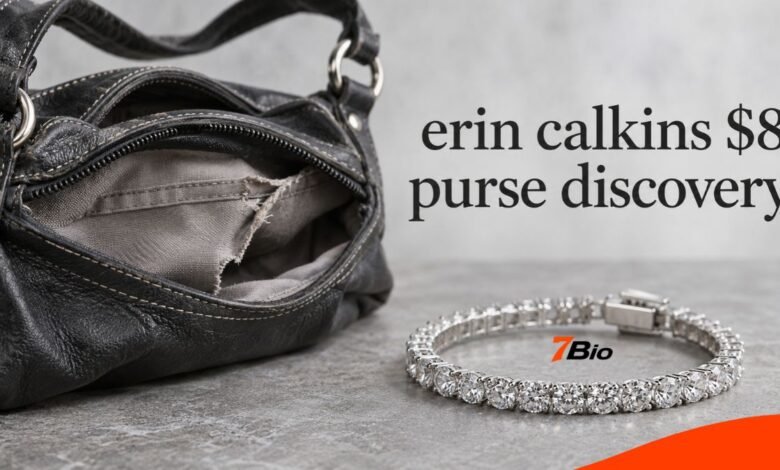
The Erin Calkins $8 purse discovery began with an inexpensive handbag purchased at a Goodwill thrift store in Atlanta, Georgia. Several weeks later, while searching for missing keys, Calkins discovered a diamond tennis bracelet concealed inside the purse’s damaged lining. After taking the jewelry to an estate jeweler, she reportedly received and accepted a $1,200 purchase offer.
The remarkable discovery attracted attention in December 2025 because of its unusual circumstances and timing. Calkins had recently lost her car in an accident and was considering a replacement when she found the bracelet. What had initially seemed like an ordinary bargain became a welcome source of money.
The story also raises useful questions about secondhand purchases, forgotten valuables, jewelry authentication, and the difference between a jeweler’s cash offer and an independent valuation.
What Happened in the Erin Calkins $8 Purse Discovery?
Erin Calkins, an Atlanta resident, was shopping with her husband at Goodwill when she noticed a handbag that matched her personal style. The couple had originally gone shopping for a white button-down shirt that her husband could wear to a wedding. Purchasing another purse was not part of their plans.
According to accounts of her interview with Newsweek, the couple had already visited another Goodwill location without finding what they needed. Their decision to visit a second store unexpectedly led Calkins to the handbag.
Her husband reminded her that she already owned enough purses, but the accessory appealed to her. At only $8, she decided to purchase it.
Nothing about the purchase immediately suggested that something valuable was concealed inside. In fact, the bracelet remained undiscovered for several weeks.
The surprising outcome depended on two ordinary events: an unplanned purchase and a later search for missing keys.
How Did Erin Calkins Find the Hidden Diamond Bracelet?
She discovered it while shopping and put her keys in an outside pocket of the secondhand purse. When she returned to her car, she could not locate them.
While examining the handbag, she noticed an opening in its internal lining. She reached through the damaged fabric to search for the missing keys and felt an unexpected object.
It was a bracelet.
The jewelry had been concealed between the handbag’s lining and its outer material, making it easy to overlook during normal use. The hidden compartment was not necessarily intentional; the opening in the fabric appears to have provided access to an otherwise inaccessible space.
This detail is central to understanding the story. Calkins was not deliberately searching for expensive jewelry or looking for hidden valuables. She was trying to retrieve something she believed she had misplaced.
The search for her keys led directly to a discovery that would later attract international attention.
Was the Jewelry a Real Diamond Tennis Bracelet?
Calkins initially believed the bracelet might be made of 14-karat white gold, but its appearance alone could not confirm whether the gemstones were genuine.
Rather than assuming that the piece was valuable, she took it to an estate jeweler for professional examination.
According to the reported account, the jeweler identified the item as a genuine diamond tennis bracelet and immediately offered to purchase it for $1,200.
Calkins accepted the offer.
A tennis bracelet typically consists of a flexible chain of individually mounted gemstones. The design is often associated with diamonds, although similar-looking jewelry can also contain alternative stones or imitation materials.
The distinction matters because appearance is not a reliable indicator of jewelry value. Metal composition, gemstone identification, condition, craftsmanship, and market demand can all influence a purchase offer.
Was the Bracelet Actually Worth $1,200?
The most clearly documented financial figure in the published accounts is the $1,200 offer the jeweler made, which Calkins reportedly accepted.
That figure should not automatically be described as a certified retail appraisal.
A jewelry buyer’s cash offer and an independent valuation are different assessments. A purchase offer reflects what one buyer is prepared to pay, whereas an appraisal may assess replacement value, fair market value, or another measure depending on its purpose.
No publicly accessible independent appraisal report was established during research for this article.
The reported $1,200 transaction remains the appropriate figure to use when discussing the financial outcome.
Why Did the Discovery Come at Such an Important Time?
The bracelet’s discovery mattered to Calkins for reasons beyond its monetary value.
She reportedly had recently been involved in an accident that resulted in her car being declared a total loss. At the time of the discovery, she needed another vehicle.
Finding an unexpected source of money was therefore particularly welcome.
While $1,200 would not necessarily cover the full cost of a replacement car, it could contribute to the purchase and related expenses.
The timing explains why the event attracted attention beyond the usual interest in valuable thrift-store discoveries. The story combined a chance purchase, a concealed object, a professional jewelry examination, and a practical financial need.
Calkins also appeared satisfied with her decision to accept the jeweler’s offer rather than search for a potentially higher price.
No independently established evidence shows how much she ultimately spent on transportation or whether the proceeds paid for a particular vehicle.
How Much Did Erin Calkins Make From the $8 Purchase?
The financial comparison is straightforward: Calkins spent $8 on the purse and reportedly received $1,200 from selling the bracelet found inside it.
The sale proceeds were 150 times the handbag’s purchase price.
However, this comparison should not be confused with a conventional investment return. Calkins bought a handbag to use, not jewelry to resell, and the bracelet was an unexpected discovery.
The handbag’s value, any incidental costs, and the precise circumstances of ownership are separate questions.
| Detail | Reported information |
|---|---|
| Shopper | Erin Calkins |
| Location | Atlanta, Georgia, United States |
| Store | Goodwill |
| Handbag purchase price | $8 |
| Unexpected discovery | Diamond tennis bracelet |
| Reported metal | 14-karat white gold |
| Jeweller’s accepted offer | $1,200 |
| Discovery timing | Several weeks after purchase |
| News coverage | December 2025 |
The figures illustrate the unusual financial outcome without implying that similar results should be expected from ordinary thrift shopping.
How Did the Story Become Popular Online?
The story received wider attention after Calkins shared her experience on Reddit and Newsweek reported on the discovery in December 2025.
Other publications subsequently repeated the account, bringing the story to audiences interested in unusual purchases, personal finance, jewelry, and secondhand shopping.
Some online reactions celebrated her luck, while others questioned whether the bracelet might have sold for more elsewhere.
Those responses reflect two different ways of interpreting the transaction. Some readers focused on the possibility of maximizing the bracelet’s resale price. Others recognized that an immediate $1,200 offer provided a practical outcome without further negotiation or uncertainty.
No verified public evidence shows that another buyer would have offered more.
The story’s appeal lies partly in the fact that a routine purchase produced an unexpected result. It also shows how objects can go unnoticed inside secondhand belongings until an unrelated event reveals them.
What Remains Unknown About the Purse and Bracelet?
Although the main sequence of events has been widely reported, several details have not been reliably established.
The reporting examined has not publicly identified the bracelet’s original owner. It is unclear how long the jewelry had been inside the handbag, whether the previous owner knew it was missing, or how the purse came to be donated.
The exact handbag brand, the bracelet’s diamond weight, and its complete gemstone specifications are also not established through independently available documentation.
Some retellings suggest that a previous owner deliberately hid the jewelry for safekeeping and later forgot about it. That explanation is possible, but it remains speculation rather than a verified fact.
Without knowing the bracelet’s history, it would be misleading to present a definite explanation for how it entered the lining.
What Can Thrift Shoppers Learn From This Discovery?
The Erin Calkins story illustrates several practical considerations for anyone buying secondhand handbags or accessories.
Examine the Condition of Secondhand Handbags
Before purchasing a used bag, inspect its seams, pockets, lining, zippers, handles, and internal compartments.
Damaged fabric can reduce durability, and objects hidden behind the lining may be hard to notice. A careful inspection helps shoppers assess condition and avoid unwelcome surprises.
If an unusual object is discovered, handle it carefully rather than pulling at sharp edges or damaging the material further.
Avoid Assuming That Jewelry Is Valuable
A decorative bracelet may resemble an expensive diamond piece without containing precious gemstones.
Metal stamps and visual appearance can provide clues, but they do not conclusively establish authenticity.
A qualified jeweler or appropriately trained appraiser can examine the item using suitable equipment and methods.
Understand the Difference Between Appraisals and Offers
The Gemological Institute of America distinguishes between gemstone grading and monetary valuation.
An independent appraisal may help establish a suitable value for a particular purpose. A dealer’s purchase offer, by contrast, reflects the amount that dealer is willing to pay.
For an unexpectedly valuable item, seeking another professional opinion may be worthwhile before selling.
Consider Ownership and Provenance
Finding a valuable item inside a secondhand purchase can raise questions about its previous ownership.
The rules governing lost or mistakenly transferred property vary by jurisdiction and circumstances. Buyers should not assume that every object found inside a purchased item is automatically theirs to keep or sell.
Where appropriate, contacting the seller or seeking local legal guidance may help clarify the situation.
Set Realistic Expectations About Thrift Shopping
An unusual discovery should not be treated as evidence that secondhand stores routinely contain valuable jewelry.
Goodwill sells donated clothing, bags, furniture, accessories, and other used goods. Most purchases are simply opportunities to obtain practical items at affordable prices.
Calkins’ experience is memorable precisely because its financial outcome was unexpected.
FAQs
1. What did Erin Calkins discover inside her $8 purse?
Erin Calkins found a diamond tennis bracelet concealed inside the damaged lining of a secondhand handbag purchased from Goodwill. A jeweler reportedly offered her $1,200 for the piece, which she accepted.
2. Where did Erin Calkins buy the purse?
She purchased the handbag at a Goodwill thrift store in the Atlanta, Georgia, area while shopping with her husband for a white dress shirt.
3. How long did it take her to find the bracelet?
She reportedly discovered it several weeks after buying the handbag. She found the bracelet while searching for keys that had disappeared into the damaged lining.
4. Did Erin Calkins sell the diamond bracelet?
Yes. Published accounts say an estate jeweler offered her $1,200 after examining the bracelet, and she accepted.
5. Why was the discovery especially meaningful?
Calkins had reportedly recently lost her vehicle in an accident and needed money towards another one. The unexpected sale provided funds at a useful moment.
Final Takeaway
The Erin Calkins $8 purse discovery demonstrates how an ordinary secondhand purchase can occasionally produce an extraordinary surprise.
A handbag bought without any expectation of financial reward concealed a diamond bracelet that Calkins reportedly sold for $1,200. She discovered it weeks after the purchase, during an unrelated search for missing keys, when she faced the cost of replacing a vehicle.
Beyond its surprising outcome, the story reminds us to examine secondhand belongings carefully, have potentially valuable discoveries professionally verified, and distinguish reported transactions from unsupported claims about market value.