
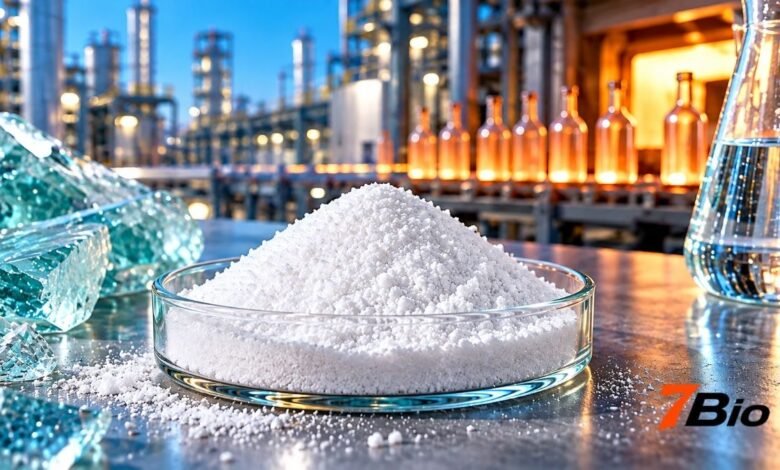
Soda ash is the common industrial name for sodium carbonate, an alkaline inorganic compound with the formula Na₂CO₃. It is a white, usually granular or powdered material used on a large scale in glass manufacturing, chemical processing, detergents, water treatment, and several other industries. Unlike baking soda, which is sodium bicarbonate, soda ash is more alkaline and is chosen when a process needs a stronger source of alkalinity or sodium carbonate. PubChem lists its molecular mass at about 105.99 g/mol.
The material can come from natural mineral deposits such as trona or be manufactured synthetically. That distinction matters because the production route, particle characteristics, and intended grade affect handling, economics, and environmental performance. For most readers, the useful questions are straightforward: what is the material, what does it do, how is it produced, and which form suits a particular application?
Quick Answer
Soda ash is sodium carbonate (Na₂CO₃). Its largest major industrial use is glassmaking, but it is also used in chemicals, detergents, pH control, water treatment, pulp and paper, and some emissions-control processes. Commercial products are commonly sold in dense and light grades, and they should not be confused with baking soda or caustic soda.
What Is Soda Ash?
Soda ash is a trade and industrial name for sodium carbonate, not a separate chemical substance. The U.S. Geological Survey defines it as sodium carbonate refined from trona or sodium-carbonate-bearing brines—generally described as natural material—or produced through chemical manufacturing routes, which are generally described as synthetic material.
Chemically, sodium carbonate is an alkali. When dissolved in water, it creates an alkaline solution, making it useful where a process needs pH adjustment, acid neutralization, or a source of carbonate ions. Its behavior in high-temperature glass batches is equally important: it acts as a flux, helping silica-containing mixtures melt more readily than silica alone.
The compound is widely traded because the same basic chemistry supports very different industries. A glass plant may value its fluxing properties; a detergent maker may value alkalinity and water-softening behavior. In contrast, a chemical plant may use it as a raw material or processing agent.
How Is Soda Ash Made?
Two broad production routes exist: recovery from naturally occurring sodium-carbonate resources and synthetic chemical manufacture.
Natural Production from Trona
Trona is a naturally occurring sodium carbonate-bearing mineral. In a typical trona-based operation, ore is mined mechanically or recovered by solution mining, processed to remove insoluble material, and then purified through combinations of heating, dissolution, filtration, crystallization, and drying.
The precise sequence depends on the plant and whether it uses a monohydrate, sesquicarbonate, or related process. U.S. life-cycle inventory documentation describes the monohydrate route as a major method for converting trona into dense sodium carbonate.
Natural production is particularly important in the United States. The USGS Mineral Commodity Summaries 2026 estimates that U.S. producers made about 12 million metric tonnes in 2025, around 3% more than in 2024. More than half of U.S. production was exported that year.
Synthetic Production
Synthetic soda ash is produced through chemical processes rather than by refining naturally occurring carbonate minerals.
The best-known route is the Solvay process, developed in the nineteenth century and still used today. In simplified form, the process uses brine, carbon dioxide, and ammonia to produce sodium bicarbonate as an intermediate; heating then converts that bicarbonate into sodium carbonate. Ammonia is recycled through the process.
The production route can influence cost and environmental performance. The USGS notes that natural producers in countries including the United States and Türkiye benefit from relatively low production costs and lower environmental impacts. At the same time, synthetic manufacture typically requires more energy. That does not mean every natural operation has the same environmental footprint; energy sources, mining methods, transport, and waste management still matter.
Dense and Light Grades: What Is the Difference?
Commercial sodium carbonate is commonly sold as dense or light grade. The underlying chemical is the same, but bulk density, particle size and handling behaviour differ.
| Feature | Dense grade | Light grade |
|---|---|---|
| Physical character | Heavier, coarser granules | Lighter, finer particles |
| Handling | Higher bulk density and relatively low dust in suitable systems | Lower bulk density and finer handling profile |
| Common applications | Glass manufacturing and bulk industrial systems | Detergents and chemical processing |
| Selection factors | Flow, segregation and bulk handling | Mixing, dissolution and formulation requirements |
Solvay describes dense grade as the form commonly preferred for glass production because its granular properties can reduce dust and segregation. Light grade is widely suited to detergent and chemical applications.
Neither grade is universally better. Industrial buyers normally compare purity, particle-size distribution, bulk density, moisture, packaging and impurity limits against their particular process requirements.
What Is Sodium Carbonate Used For?
Glass Manufacturing
Glass is the largest single end-use category in current U.S. data. In a glass batch, the compound acts as a flux, helping lower the temperature required to melt silica-rich raw materials. It is used in flat glass for buildings and vehicles, container glass, and other glass formulations.
The USGS 2026 summary reports the following estimated U.S. end-use distribution for 2025:
| U.S. end use | Estimated share |
|---|---|
| Glass | 45% |
| Chemicals | 28% |
| Miscellaneous uses | 9% |
| Distributors | 7% |
| Soaps and detergents | 5% |
| Flue-gas desulfurisation | 4% |
| Pulp and paper | 1% |
| Water treatment | 1% |
These figures describe the United States, not global consumption, so they should not be presented as worldwide market shares.
Chemicals and Industrial Processing
Sodium carbonate is used as a feedstock or processing aid in manufacturing other sodium compounds and chemicals. Its alkalinity also makes it useful for pH adjustment, neutralization, and process control.
Because industrial chemistry is application-specific, the required purity and dosage can vary substantially between processes. A grade selected for glassmaking, for example, may have different handling requirements from one intended for a specialized chemical formulation.
Detergents and Cleaning Products
In detergents, sodium carbonate can increase alkalinity, support the removal of greasy soils and help soften hard water by reducing the effect of calcium and magnesium ions.
Commercial detergent formulation is more complex than simply adding an alkali. Manufacturers therefore choose particle characteristics, grade, and concentration based on the design of the finished cleaning product.
Water Treatment and pH Control
The compound can raise pH and alkalinity in some water-treatment applications.
The correct amount depends on the starting water chemistry, treatment objective and equipment involved. Dosing should therefore follow established treatment procedures and product instructions rather than a universal quantity.
Pulp, Paper and Emissions Control
Sodium carbonate also appears in pulp and paper processing and in certain flue-gas desulfurization systems.
These categories are smaller than glass and chemicals in current U.S. end-use data, but they demonstrate how widely the material is used across industrial operations.
How It Differs from Baking Soda, Washing Soda and Caustic Soda
Several similar names are used around sodium-based alkaline chemicals, but they are not interchangeable.
Soda ash is anhydrous sodium carbonate (Na₂CO₃).
Baking soda is sodium bicarbonate (NaHCO₃). It is a separate compound and is less alkaline. PubChem identifies sodium bicarbonate as baking soda and lists its formula as NaHCO₃.
Washing soda commonly refers to sodium carbonate decahydrate (Na₂CO₃·10H₂O), which contains water of crystallization. PubChem’s sodium carbonate record identifies the decahydrate form as washing soda.
Caustic soda is sodium hydroxide, NaOH. It is a different chemical and is substantially more corrosive; PubChem describes sodium hydroxide as corrosive to tissue and metals.
The practical rule is simple: an industrial process, cleaning method, treatment procedure or formulation written for one of these chemicals should not automatically be applied to another.
Safety and Handling
Sodium carbonate is alkaline and should be handled with appropriate care. Under the European Union’s harmonized classification, sodium carbonate is classified as Eye Irritant Category 2. Therefore, when handling powder in quantity, use dust control, suitable eye protection, and good industrial hygiene.
Keep the material dry and in suitable closed packaging. Workplace users should follow the supplier’s current safety data sheet for protective equipment, storage, spill response and first-aid procedures.
Industrial material should also not be assumed to be food, pharmaceutical, or laboratory grade merely because its chemical identity is the same. Suitability depends on the individual product specification and intended use.
Environmental and Supply Considerations
The environmental profile depends strongly on how the material is produced.
Natural trona-based processing avoids some of the chemical-manufacturing steps required by synthetic routes, while mining itself creates energy, land-management, tailings, processing, and transport considerations. Synthetic manufacture can be practical where suitable mineral resources are unavailable, but current USGS reporting shows its energy requirements are generally higher.
Recycling affects demand indirectly. USGS reports that producers did not recycle sodium carbonate itself, but glass manufacturers use recycled cullet, which reduces the amount of virgin raw material needed in glass production.
How to Choose the Right Product
For an industrial purchase, start with the application rather than the brand name. Confirm whether you need a dense or light grade, then compare purity, particle size, bulk density, moisture, contaminant limits, packaging, and any regulatory or quality requirements relevant to the process.
For household or small-scale applications, use a product specifically labeled for the intended task. Avoid substituting an industrial-grade chemical into food, personal-care or other sensitive applications unless the product is explicitly specified and approved for that use.
FAQs
Is soda ash the same as sodium carbonate?
Yes. Soda ash is the common industrial and trade name for sodium carbonate (Na₂CO₃). The name refers to the same chemical, not a separate compound.
Is soda ash the same as baking soda?
No. Baking soda is sodium bicarbonate, NaHCO₃, while the industrial alkali discussed here is sodium carbonate, Na₂CO₃. Their chemistry, alkalinity, and uses differ.
Why is it used in glass?
It acts as a flux in a glass batch, helping silica-rich raw materials melt at a lower processing temperature than silica alone. This is one reason glass remains its largest U.S. end-use category.
What is the difference between light and dense grades?
Both are sodium carbonate, but they differ in particle characteristics and bulk density. Dense material is commonly preferred for glassmaking, while light material is widely used in detergent and chemical applications.
Is sodium carbonate dangerous?
It is not handled like a highly corrosive alkali such as sodium hydroxide, but it can irritate the eyes, and airborne dust should be controlled. Workplace users should follow the current safety data sheet and appropriate PPE requirements.
Can sodium carbonate be used to raise pH?
Yes. Its alkalinity makes it useful for pH and alkalinity adjustment in several industrial and water-treatment applications. The correct dose depends on the chemistry of the specific system, so don’t assume a generic amount.
Final Takeaway
Sodium carbonate is a comparatively simple chemical with a major industrial role. Soda ash supports glass production, chemical manufacturing, detergents, water treatment, and several specialized processes.
The most useful distinctions are whether it comes from a natural or synthetic route, whether the product is light or dense grade, and whether its specification matches its intended application. Understanding those differences prevents a common mistake: treating every form of sodium carbonate—or every similarly named sodium chemical—as interchangeable.