
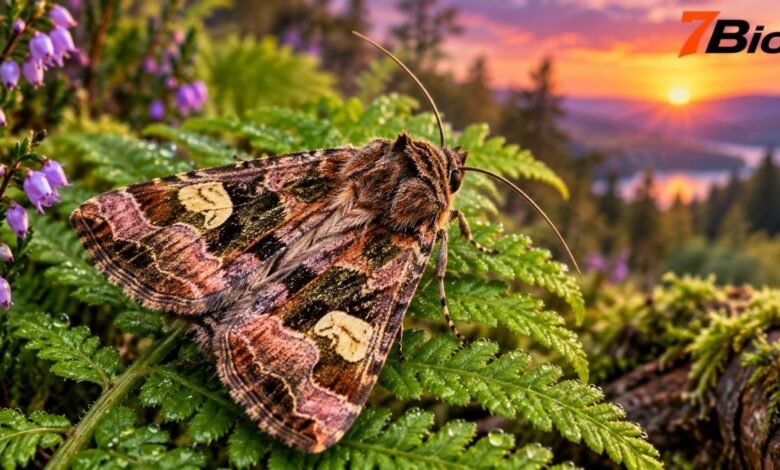
The term lucipara can look mysterious when it appears alone in search results, but established zoological sources most clearly document it as part of the scientific name Euplexia lucipara. This is the small-angle shade, a nocturnal moth in the family Noctuidae. The Natural History Museum and GBIF taxonomy records recognize Euplexia lucipara as a valid species, with its scientific history tracing back to Carl Linnaeus in the eighteenth century.
For British readers, the species is particularly relevant because it is widespread across much of the British Isles. It occurs in woodland, parks, gardens, and other vegetated habitats and can be attracted to artificial light at night.
This guide uses lucipara specifically in this zoological sense. It does not treat unsupported online descriptions of the word as a general term for glowing or bioluminescent organisms as established scientific fact.
Quick Answer
Lucipara refers here to Euplexia lucipara, commonly called the small angle shades moth. It is a noctuid moth found across Britain and elsewhere in the Palaearctic, with adults in Britain most commonly recorded from late spring through midsummer and occasional later emergences.
What Is Lucipara?
Euplexia lucipara is a species of moth in the order Lepidoptera and family Noctuidae. GBIF places it within the genus Euplexia, while the Natural History Museum’s Global Lepidoptera Names Index records the accepted combination as Euplexia lucipara and the original combination as Phalaena (Noctua) lucipara.
The species is commonly known in Britain as the small angle shades.
A simple classification is:
ClassificationName
Kingdom Animalia
Phylum Arthropoda
Class Insecta
Order Lepidoptera
Family Noctuidae
Genus Euplexia
Species Euplexia lucipara
Common name Small Angle Shades
The scientific name should therefore not be confused with an independently established scientific category called “lucipara”. Authoritative taxonomy databases document it primarily as a species name.
How to Identify Euplexia lucipara
The small angle shades is a compact, strongly patterned moth. UKMoths gives a wingspan of 27–32 mm, while some regional identification resources use approximately 30–35 mm, illustrating the small differences that can occur between published measurement ranges.
Its forewings combine dark brown, pinkish-brown and paler areas. One particularly useful feature is the pale or golden mark towards the outer part of each forewing. Northern Ireland’s moth guide describes a golden blotch near the forewing apex, with pinkish coloring across the median area.
Derbyshire Moths similarly highlights a contrasting gold-yellow kidney-shaped mark against darker central coloring.
The pattern can vary between individuals, so identify it by the overall combination of size, markings, wing shape, resting position, and location, rather than a single color.
Its Unusual Resting Posture
One of the more helpful field clues is how the moth holds its wings.
Hampshire Moths notes that the forewing folds in along the costa when the insect is resting, a posture also seen in the larger angle shades moth.
This folded shape helps break up the moth’s outline when it rests among vegetation.
Where Does Lucipara Live?
In Britain, lucipara is associated with a surprisingly broad range of habitats.
UKMoths describes the small angle shades as widespread over much of the British Isles, particularly in woodland, parkland and suburban areas.
Regional ecological data broaden that picture further. Durham Moths lists habitats including woodland, scrub and hedgerows, heathland, moorland and both broadleaved and coniferous woodland.
That variety helps explain why the species may turn up away from what people think of as traditional moth habitat. A garden close to mature trees, hedges, ferns or semi-natural vegetation can potentially fall within suitable surroundings.
At a wider geographic level, Natural History Museum records place the species in both western and eastern Palaearctic regions, while European moth resources document its occurrence across numerous European countries.
When Can You See the Small Angle Shades?
The main British flight period occurs around late spring and summer.
UKMoths states that adults typically fly during June and July, sometimes followed by a later generation during August or September. Its associated NBN Atlas data show that records are concentrated particularly between May and July.
Regional timing can differ.
For example, the Northern Ireland account gives a principal period from mid-May into early August, while Sussex records indicate a mainly single-brooded population with occasional later emergence.
These differences are not necessarily contradictions. Insects respond to geography, seasonal temperatures, and local conditions so that exact dates can vary between regions and years.
What Do the Caterpillars Eat?
The larvae of Euplexia lucipara are not restricted to one food plant.
Bracken is one of the best-documented plants associated with the species. UKMoths also records other ferns, low-growing plants and trees as larval foods.
British trait data presented by Durham Moths include plants such as:
- bracken and other ferns
- nettles
- foxglove
- birch
- willow
- oak
- hazel
- ivy
- currants
- mallows
The underlying habitat and food-plant information links to published British butterfly and macro-moth trait datasets.
This broad diet helps explain why lucipara can occupy several different habitats rather than depending entirely on one specialized plant.
What Happens During Its Lifecycle?
Like other moths, the small angle shades develops through egg, larval, pupal and adult stages.
Its caterpillars are largely nocturnal feeders. UKMoths specifically notes that larvae feed at night, while Hampshire Moths reports that the species overwinters as a pupa.
Adult moths are also predominantly nocturnal and readily visit lights, which is why the species regularly appears in moth traps and garden-light observations.
For anyone recording one, the most useful information is not simply the photograph. The date, location, habitat, and observation method can make a wildlife record substantially more informative.
Small Angle Shades vs Angle Shades
The similar common names can cause confusion, but the two moths are noticeably different in size.
| Feature | Small Angle Shades | Angle Shades |
|---|---|---|
| Scientific name | Euplexia lucipara | Phlogophora meticulosa |
| UKMoths wingspan | 27–32 mm | 45–50 mm |
| Main British activity | Primarily late spring to midsummer | Mainly May–October |
| Family | Noctuidae | Noctuidae |
| Resting feature | Folded forewing shape | Strongly folded, leaf-like appearance |
UKMoths records the angle shades at around 45–50 mm across the wings, making it substantially larger than the small angle shades.
The common name therefore does not simply mean that Euplexia lucipara is an identical miniature version. Its pattern and overall appearance have their own distinctive features.
Is Lucipara Bioluminescent?
There is no reliable taxonomic basis for describing Euplexia lucipara as a bioluminescent moth.
Authoritative records from GBIF, the Natural History Museum, and NCBI identify it as a noctuid moth species. Those sources document its taxonomy and genomic or nomenclatural status; they do not establish “lucipara” as a biological category for organisms that produce light.
This distinction matters because unusual keywords can accumulate unsupported definitions when one webpage repeats claims from another.
For factual publishing, the safer approach is to follow established taxonomy rather than derive meaning from the word’s spelling alone.
Why Is the Small Angle Shades Useful to Record?
Common species still matter to biological recording.
Individual sightings contribute information about distribution, seasonal activity, and changes in where and when species are observed. UKMoths currently incorporates large numbers of NBN Atlas records into its flight-period and distribution information.
A good record normally includes a clear photograph where possible, the observation date, approximate location and relevant habitat notes.
Avoid handling wildlife unnecessarily to obtain a better photograph.
FAQs
What does lucipara mean in moth identification?
In moth identification, it appears as the specific name in Euplexia lucipara, the small angle shades moth.
Is Euplexia lucipara found in Britain?
Yes. British moth resources describe the species as widespread across much of the British Isles.
When is the small angle shades usually seen?
British observations are concentrated mainly from late spring through July, although later adults can occur in some years and regions.
What plants do its caterpillars eat?
Bracken and other ferns are well documented, along with numerous herbaceous plants, shrubs, and trees.
Is the small angle shade the same as the angle shade?
No. They are different species. The small angle shades is Euplexia lucipara, while the larger angle shades is Phlogophora meticulosa.
Does lucipara produce light?
Reliable taxonomic sources do not document Euplexia lucipara as a bioluminescent moth. Claims giving the word a general “light-producing organism” definition should therefore be treated cautiously unless supported by an appropriate scientific source.
Final Takeaway
In this context, Lucipara is best understood as Euplexia lucipara, the small angle shades moth. It is a relatively small, patterned noctuid found widely across Britain, with woodland, parkland, gardens and other vegetated environments providing suitable habitat.
Its golden-pale wing markings, compact size, folded resting position and summer flight period can help with identification. Most importantly, reliable taxonomy provides a much firmer basis for understanding the keyword than speculative meanings circulating on lightly sourced websites.