
Sruhl Meaning and Origin: The Fascinating Story Behind This Rare Yiddish Name
A careful look at the historical spelling, its connection to Srul and Yisrael, and why the name appears differently across genealogical records.

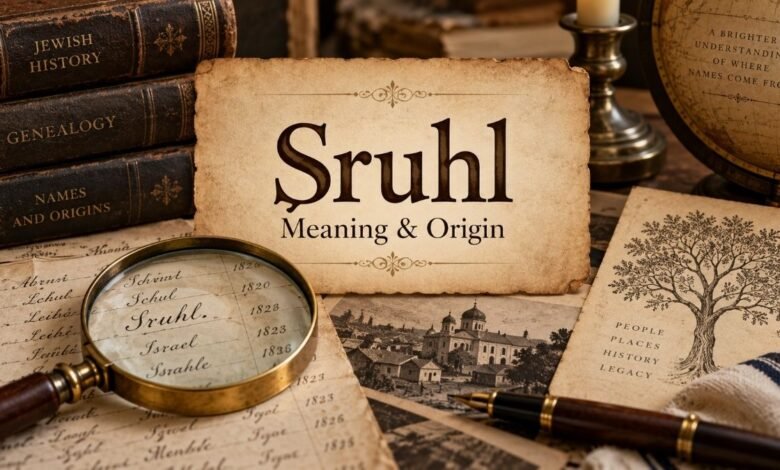
Sruhl is an uncommon spelling associated with a traditional Yiddish form of the Hebrew name Yisrael, usually written in English as Israel. The better-documented Yiddish form is Srul, while historical records and family histories show that spellings such as Sruhl and Shrul can also appear. That variation matters because older Jewish names were often recorded phonetically as families moved between languages, alphabets, and countries.
For anyone encountering sruhl in an immigration document, census, family tree, or historical database, the safest interpretation is not to assume it represents an entirely separate modern name. Check the surrounding record for forms such as Srul, Shrul, Yisrael, or Israel. JewishGen’s material on Hebrew and Yiddish given names specifically identifies Srul as a Yiddish form derived from Yisrael, while historical Jewish records preserve the Sruhl spelling itself.
Quick Answer
Sruhl appears to be a rare transliterated spelling related to Srul, a traditional Yiddish shortened form of Yisrael, or Israel. The spelling matters in genealogy because the same person’s name may have been recorded differently in Yiddish, Hebrew, Russian, Polish, Romanian, English, or other languages.
What Does Sruhl Mean?
Understanding sruhl begins with understanding the relationship between Hebrew and Yiddish personal names.
JewishGen’s educational material on given names explains that Yiddish nicknames could be produced by shortening Hebrew names. One example is Yisrael becoming Sruhl. This provides a much firmer linguistic basis than trying to assign an independent dictionary meaning to the unusual spelling Sruhl.
In practical terms, Sruhl should therefore usually be investigated as a spelling variant within the Yisrael–Srul name family, rather than automatically treated as an unrelated name.
The Hebrew name Yisrael is commonly rendered as Israel in English. Yiddish usage produced forms including Srul and related diminutives, and transliteration into the Latin alphabet created additional spelling differences.
This distinction is important. A historical spelling does not necessarily represent a different original name. It may simply show how a clerk, translator, researcher, or family member heard and represented the pronunciation.
Is Sruhl the Same as Srul?
In many historical or genealogical contexts, Sruhl and Srul may represent closely related renderings of the same traditional name, but researchers should not automatically merge every record without supporting evidence.
The clearest linguistic evidence concerns Srul, which JewishGen directly identifies as developing from Yisrael. The exact Sruhl spelling is less standardized, but it appears in historical Jewish records. A JewishGen-hosted transcription of the 1795 Dashev census, for example, records a man with the given name Sruhl and separately identifies other residents through patronymic descriptions such as “son of Sruhl.”
That historical appearance matters because it shows Sruhl is not simply a recently invented internet spelling.
A separate documented family history also records an ancestor as Sruhl or Shrul. It associates those forms with Israel, illustrating how one individual could be known under several spellings across different records.
Why Do the Spellings Change?
Names that moved between Hebrew or Yiddish and languages using the Latin or Cyrillic alphabets did not always have one universally enforced spelling.
A spoken name could therefore appear differently depending on who recorded it. Srul, Shrul and Sruhl may look noticeably different on the page while still pointing a genealogist toward the same linguistic name family.
This is one reason experienced family-history research should focus on more than spelling alone. Dates, parents, spouses, occupations, towns, and migration history can be equally important when determining whether two records describe the same person.
Historical Evidence for the Sruhl Spelling
One of the most useful pieces of evidence comes from historical Jewish population records.
In a transcription of the 1795 Jewish census for Dashev, JewishGen lists “Sruhl, age 44, son of Ruvin.” The same record contains people described as sons of Sruhl, showing the spelling functioning as an actual given name within the historical material rather than merely as a modern search term.
Later Jewish records also demonstrate similar naming patterns. A transcription of 1883 death records from Peschanka, for example, includes the compound paternal name Sruhl-Gersh.
These examples should not be used to claim that one spelling was universal. They show something more useful: Sruhl existed as a recorded historical form, while Srul has stronger documentation as the conventional Yiddish form connected with Yisrael.
Sruhl, Srul, Shrul and Israel Compared
| Form | How it should be understood | Research relevance |
|---|---|---|
| Sruhl | Rare historical/transliterated spelling | May appear in older genealogical records |
| Srul | Documented Yiddish shortened form of Yisrael | Strong starting point for name research |
| Shrul | Alternative phonetic/transliterated form | Worth checking when searching family records |
| Yisrael | Hebrew-name form | May appear in religious or Hebrew-language contexts |
| Israel | Common English rendering | Frequently encountered in later civil records |
The table is best treated as a research guide rather than a rule that every occurrence refers to the same individual.
Why Sruhl Matters in Genealogy Research
Rare spellings can become surprisingly important when researching Jewish families from Central and Eastern Europe.
A researcher searching only for “Israel” may overlook a census or community record indexed under Sruhl. Someone searching only Srul may similarly miss a handwritten record transcribed as Shrul.
This is particularly relevant when tracing ancestors across migration. An individual might have been recorded using a Yiddish everyday name in one document and a Hebrew, Russian-language, or Anglicized form in another.
Search the Name as a Group of Variants
When researching a possible Sruhl ancestor, it is sensible to check several variations rather than relying on an exact-match search.
Useful possibilities include Sruhl, Srul, Shrul, Yisrael and Israel. Researchers may also encounter related diminutive spellings depending on the archive and language involved.
The objective is not to declare all of these names interchangeable. It is to widen the search intelligently and then compare the underlying biographical information.
Check More Than the Name
A spelling match by itself is weak evidence.
A stronger identification looks for agreement across several details, such as birthplace, approximate age, parents, spouse, children, residence, and occupation. When several of these elements align, a spelling difference becomes easier to explain as transliteration rather than evidence of a separate person.
Is Sruhl a Surname?
The current evidence is much stronger for Sruhl as a historical given-name spelling or transliterated form than for treating it primarily as a surname.
Search databases can surface similar strings in surname indexes, usernames, and email addresses, but resemblance alone does not establish a shared origin. A person researching a modern family surname should therefore investigate that family’s documentary history separately rather than assuming it derives from the Yiddish Srul.
This is an important limitation because rare names can develop independently or be altered substantially through migration and record-keeping.
Common Mistakes When Researching Sruhl
One common mistake is assuming that every unusual spelling has a completely separate meaning. Historical transliteration makes that unreliable.
Another is replacing Sruhl with Israel automatically without examining the document. The linguistic connection is useful, but you still need to demonstrate genealogical identity from the rest of the record.
It is also risky to depend on unsourced name-meaning websites. Genealogical archives and specialist Jewish-name resources are generally more useful because they can show how names were actually recorded and transformed.
Finally, modern search-engine results containing the letters “sruhl” may represent usernames, initials plus surnames, or email prefixes. Those results do not establish the name’s historical meaning.
Frequently Asked Questions
What is the meaning of Sruhl?
Sruhl is best understood as a rare spelling connected with Srul, the documented Yiddish shortened form of Yisrael, or Israel. The exact spelling varies across historical records.
Is Sruhl a Jewish name?
Historical Jewish records contain the Sruhl spelling, while Jewish naming research documents Srul as a Yiddish form derived from Yisrael. The historical context therefore strongly associates the name with Jewish and Yiddish naming traditions.
Are Sruhl and Israel the same name?
They can belong to the same naming tradition, but researchers should not assume that every person called Sruhl must appear elsewhere as Israel. Compare individual records before identifying two entries as the same person.
What other spellings should genealogists search?
Useful variants include Srul, Shrul, Yisrael and Israel, with additional spellings possible depending on language and transcription.
Is Srul better documented than Sruhl?
Yes. Specialist Jewish-name material directly identifies Srul as a Yiddish form of Yisrael. Sruhl is supported mainly through historical and genealogical examples, making it a rarer written variant.
Why does Sruhl have so many possible spellings?
Yiddish and Hebrew names were repeatedly transcribed into different alphabets and languages. Pronunciation, local spelling conventions, and individual clerks could therefore produce multiple Latin-alphabet forms of a similar spoken name.
Final Takeaway
Sruhl is a rare but historically documented name spelling, most usefully understood in connection with the Yiddish Srul and Hebrew Yisrael/Israel. Evidence supports Srul as a Yiddish shortened form of Yisrael, while genealogical records demonstrate that Sruhl itself appeared in historical documentation.
For family-history research, the key lesson is not to rely on one spelling. Search related forms, compare the complete record, and treat transliteration differences as clues rather than automatic proof of identity.