Semana S 2026: A Remarkable National Event That Brought Education, Business and Communities Together
Discover how Brazil's nationwide initiative connected millions of service attendees with professional training, cultural experiences, public services, and business opportunities.

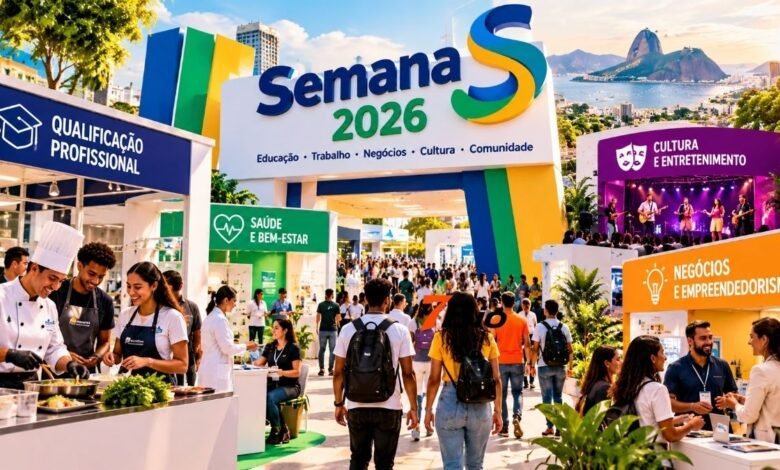
Semana S 2026 brought together educational institutions, business organizations and local communities across Brazil through a nationwide program of free activities. Held primarily on 15 and 16 May 2026, the second edition offered professional training, career guidance, health services, cultural performances and opportunities for entrepreneurs to connect with business-support organizations.
Organized through Brazil’s Sistema Comércio, the initiative involved the Confederação Nacional do Comércio de Bens, Serviços e Turismo (CNC), Sesc, Senac, state commerce federations and business associations. Its purpose extended beyond attracting large crowds. It introduced people to services that could support their education, employment prospects, wellbeing, and participation in community life.
The event also achieved a substantial increase in its reported reach. According to the CNC’s post-event assessment, the 2026 edition recorded more than three million in-person service attendances nationwide, demonstrating how regional organizations can coordinate activities at a national scale.
To understand the event, look beyond the headline figures to what was offered, who could participate, and why its mix of public services and business development drew attention.
What Was Semana S 2026?
Semana S 2026 was a national Brazilian initiative designed to connect the public with services provided by Sistema Comércio, particularly through Sesc and Senac. It combined educational programs, health and wellbeing activities, entrepreneurship support, cultural entertainment, and practical services nationwide.
The name refers to the Sistema Comércio institutions that help deliver services to people working in commerce, services and tourism, as well as the wider population. Although the name translates roughly to “S Week”, the initiative is not the same as Semana Santa, Brazil’s Holy Week observance.
The event followed its first national edition in 2025. It was designed to make participating institutions’ activities more visible and accessible, while encouraging people to explore programs that continue beyond the event itself.
A key feature was the mix of activities for different audiences. Students could explore professional training, entrepreneurs could attend a business discussion, and families could participate in cultural or recreational programs. Rather than functioning as a conventional trade exhibition, it brought together several forms of social and economic support in one coordinated initiative.
When and Where Did Semana S 2026 Take Place?
The main national dates were Friday, 15 May, and Saturday, 16 May 2026. However, some states organized broader programs, with additional activities before or after the central event dates.
The activities were distributed across numerous Brazilian cities. Locations included Sesc facilities, Senac educational centers, public squares, cultural venues, parks, and spaces operated by commerce federations.
Regional organizers adapted the program to local needs, available facilities, and participating partners. As a result, no single timetable covered every state.
| Event Detail | Confirmed Information |
|---|---|
| Event name | Semana S do Comércio de Bens, Serviços e Turismo |
| Main dates | 15–16 May 2026 |
| Country | Brazil |
| Edition | Second national edition |
| National coordination | CNC |
| Main participating institutions | Sesc, Senac, Fecomércio and business associations |
| Admission | Free for the general event programme, subject to individual activity rules |
| Activities | Training, health, culture, entrepreneurship and community services |
| Reported nationwide reach | More than 3 million in-person service attendances |
| Next edition | Organisers indicate a return in 2027 |
The distinction between the core national dates and extended state programs matters when reviewing past attendance reports. Some regional totals include activities conducted over several days rather than exclusively on the two principal dates.
How Sistema Comércio Organized the National Program
Semana S 2026 depended on cooperation among institutions with different responsibilities. Their combined participation allowed the program to offer both professional development and community-oriented experiences.
The Role of CNC and Fecomércio
The Confederação Nacional do Comércio (CNC) coordinated the national initiative, while state commerce federations helped develop regional activities. These organizations represent the interests of businesses in commerce, services, and tourism.
Their involvement was especially significant for entrepreneurship programs, professional discussions, and events that connected business owners with institutional support.
Regional federations helped select suitable venues, organize local partnerships, and communicate registration requirements. This decentralized approach allowed activities to reflect economic and social conditions across Brazil.
The Contribution of Sesc
The Serviço Social do Comércio (Sesc) played an important role in the cultural, recreational, educational and wellbeing components. Its activities included opportunities for community participation, physical activity, cultural experiences and access to selected health-related services.
Sesc’s contribution made the initiative relevant to people who were not necessarily business owners or actively seeking professional qualifications.
Families, older residents and younger participants could benefit from programs that brought services and cultural experiences into accessible public settings.
Senac and Professional Education
The Serviço Nacional de Aprendizagem Comercial (Senac) focused strongly on education, occupational skills and professional development.
Its participation connected visitors with workshops, training opportunities, practical demonstrations and career-oriented information.
The approach reflected the importance of vocational education in sectors such as hospitality, retail, technology, gastronomy and customer service, where practical skills can influence employment opportunities and professional progression.
Free Activities and Services Available During the Event
One defining characteristic of Semana S 2026 was the diversity of its activities. Rather than offering only lectures or entertainment, organizers combined services with experiences that could introduce participants to unfamiliar professional and educational opportunities.
Professional Training and Career Development
Training activities were among the most practically useful elements. Depending on the state, visitors could attend professional workshops, career consultations, technical demonstrations, and learn about training programs.
In Maranhão, for example, Senac announced more than 1,400 free vocational training places associated with the event—the availability of specific courses varied by location and program requirements.
These opportunities were particularly relevant for young people entering the labor market, workers considering a career change and adults wanting to improve practical skills.
However, an event workshop should not automatically be treated as equivalent to a formal professional qualification. Course length, eligibility, and certification requirements depended on the individual program.
Business Development and Entrepreneurship
The business-focused activities connected entrepreneurs and commerce professionals with discussions about innovation, leadership, customer relationships and commercial development.
In some regions, organizers arranged presentations by experienced speakers and networking opportunities for business representatives.
For small businesses, the practical value of these activities lies in gaining access to information and institutions that may otherwise be hard to find.
An entrepreneur attending a professional discussion might learn about training services, identify relevant business support, or connect with a local federation. These are possible benefits, not guaranteed commercial outcomes.
Health, Wellbeing and Community Services
Community-oriented activities helped make the initiative relevant beyond the business sector.
Regional programs included health guidance, preventive care activities, wellbeing services, and educational information. The specific services varied by location and depended on the professionals and facilities available.
Some states also included physical activities, organized walks, and sports events designed to encourage community participation.
Understand the health-related services offered during a public event according to their stated scope. Basic guidance or screening does not replace a comprehensive medical assessment when one is necessary.
Culture, Entertainment and Family Activities
Cultural programming gave communities another reason to participate.
Regional events featured musical performances, artistic presentations and activities suitable for different age groups. These programs helped connect broader audiences with the educational and social services offered by the participating institutions.
Combining entertainment with practical information also introduced visitors to organizations whose wider activities they might not have known about.
Regional Highlights Across Brazil
Although nationally coordinated, Semana S 2026 had distinctive regional programs. A few examples show how the initiative balanced shared objectives with local priorities.
Belém, Pará: Education, Technology and Culture
In Belém, organizers announced more than 150 activities across several city locations.
The program included health and wellbeing activities at Sesc Doca, gastronomy and hospitality experiences at Senac facilities, and technology-oriented activities involving innovation, games and digital learning.
The events also incorporated public cultural performances.
This arrangement demonstrates how different institutions could contribute specialized activities while participating in one broader initiative.
Curitiba, Paraná: Wellbeing and Professional Knowledge
Paraná organized an extended program during the week around the central national dates.
In Curitiba, Parque Barigui hosted much of the program on 15 and 16 May. The announced schedule included more than 200 sporting, educational, cultural and gastronomic activities.
Wellbeing and professional development featured prominently, including discussions on health, aging, and care.
This combination reflected an approach that connected quality of life with workplace and community concerns.
Macapá, Amapá: Innovation and Community Participation
In Macapá, activities included business presentations, professional development sessions, community services and recreational events.
A major program took place at Senac Amapá, while the Praça da Bandeira hosted public entertainment.
The state’s commerce federation reported serving more than 66,000 people across its broader program, including large public gatherings.
The events also highlighted emerging technologies through practical experiences involving digital tools and demonstrations.
These examples show the national initiative wasn’t limited to one type of venue or audience.
The Results: More Than Three Million Service Attendances
Organizers’ post-event assessments made the scale of Semana S 2026 clearer.
At a CNC leadership meeting on 21 May 2026, the organization reported more than three million in-person service attendances across Sesc and Senac’s combined activities.
A subsequent Senac report gave the following institutional figures:
| Institution | Reported 2026 Figure |
|---|---|
| Sesc | 2,464,132 people served |
| Senac | 616,016 participants or service attendances |
| Combined reported total | More than 3 million |
These figures need careful interpretation. Service attendances are not necessarily the same as unique individuals. Someone receiving more than one service, or participating in multiple activities, may contribute to more than one recorded attendance.
The figures should therefore not be presented as proof that more than three million distinct people attended the event.
Nevertheless, the reported scale demonstrates substantial institutional reach. It also suggests that education, wellbeing and cultural activities can attract strong public engagement when organized through an established national network.
How Did the 2026 Edition Compare With 2025?
The inaugural national edition in 2025 recorded approximately 1.2 million in-person attendances, according to the CNC’s retrospective reporting.
By comparison, the 2026 results exceeded three million.
That represents a substantial increase in reported service activity. However, the available headline totals do not independently establish how much of the growth came from additional visitors, more services per person, or expanded reporting coverage.
The distinction is essential for understanding the figures responsibly. Higher attendance totals show greater recorded activity, but they alone do not measure long-term educational, economic, or health outcomes.
Why the Event Matters for Brazil’s Economy
Semana S 2026 mattered because it brought together two areas often treated separately: support for businesses and access to services that benefit the wider population.
Brazil’s commerce, services and tourism sectors rely on workers with a broad range of technical, interpersonal and managerial skills. Professional education therefore matters not only to individual careers but also to the businesses that depend on qualified staff.
An initiative that connects vocational training with entrepreneurship discussions can help people explore both sides of this relationship.
For example, hospitality businesses require trained workers in food preparation, guest services and management. Professional education programs build these capabilities, while business associations can give companies opportunities to exchange ideas and identify support.
The public-service dimension adds another layer. Health and cultural programs serve communities in ways that immediate commercial measures do not always reflect.
The event illustrates how business-supported institutions can offer services spanning employment, education, leisure and community development.
What Made the 2026 Edition Different?
Several features distinguished the second national edition.
First, its reported scale was considerably larger than that of 2025. Second, its activities covered a wide range of interests, from professional development to public entertainment. Third, regional institutions could design programs around their local audiences.
The event also created opportunities for direct interaction between the public and organizations that offer services throughout the year.
This last point is particularly important. A two-day event has limited value if its benefits disappear immediately afterward. The greater potential lies in introducing participants to continuing educational programs, community services and professional networks.
Whether these connections produce lasting results depends on factors that attendance figures alone cannot show, including subsequent enrolment, program completion, and employment outcomes.
Lessons for Future National Business and Community Events
Semana S 2026 offers several useful observations for organizations planning large public initiatives.
Accessibility matters. Free activities can reduce an immediate financial barrier, but travel costs, accessibility needs, and limited program capacity may still affect participation.
Local flexibility can improve relevance. A nationally coordinated event doesn’t have to offer the same program everywhere. Regional organizations can respond to community interests and available expertise.
Clear information supports participation. Accurate schedules, registration instructions, eligibility requirements and venue details help visitors identify activities that suit their needs.
Attendance is only one measure of success. Future reporting can provide a fuller picture by examining training enrolments, completed programs, continued service use, and other measurable outcomes.
These lessons extend beyond Brazil. Similar principles apply to education fairs, professional development initiatives, public-service exhibitions, and business-community partnerships.
What Happens After the 2026 Event?
The national program has concluded, and its official website now looks ahead to 2027.
People interested in the previously offered activities can still explore the regular services provided by Sesc, Senac, and their respective regional organizations.
However, don’t assume a particular workshop, free course, or community service is available just because it appeared in the event program.
Anyone seeking training should check the current course schedule of the relevant Senac regional office. Those interested in cultural or recreational activities can consult their local Sesc organization.
The next national edition offers an opportunity to assess whether the 2026 expansion continues and how organizers improve reporting on longer-term benefits.
FAQs
1. What exactly was Semana S 2026?
It was the second edition of a Brazilian national initiative organized through Sistema Comércio. The event brought together free educational, cultural, community and business-focused activities supported by institutions including CNC, Sesc, Senac and Fecomércio.
2. Was the event completely free to attend?
The main initiative was promoted as free to the public. However, some activities required advance registration, had limited places, or required local participation. These requirements varied by state and program.
3. How many people attended the 2026 edition?
Organizers reported more than three million in-person service attendances nationwide. This figure represents recorded service activity and should not automatically be interpreted as the number of distinct individuals.
4. Could people outside the commerce sector participate?
Yes. Although institutions associated with commerce, services, and tourism organized the initiative, its wider program also welcomed students, families, entrepreneurs, and members of the general public. Individual activity eligibility could vary.
5. Did participants receive certificates for workshops?
Certification depended on the individual activity or training program. Attendance at an exhibition or short workshop did not automatically guarantee a professional qualification or certificate.
6. Will Semana S return in 2027?
The official event website indicates that the initiative will return in 2027. Check specific dates, locations, activity schedules, and registration arrangements against future announcements from the organizers.
Final Takeaway
Semana S 2026 demonstrated the scale of cooperation possible between business organizations, education providers and community-service institutions. Its combination of professional training, health activities, cultural programs and business support made it relevant to several different groups within Brazilian society.
The national event took place primarily on 15 and 16 May and generated more than three million reported in-person service attendances. Its regional programs illustrated how a coordinated initiative can maintain a shared purpose while addressing different local needs.
The most meaningful legacy will depend not only on the number of services delivered during the event, but also on the opportunities participants continue to access afterward.