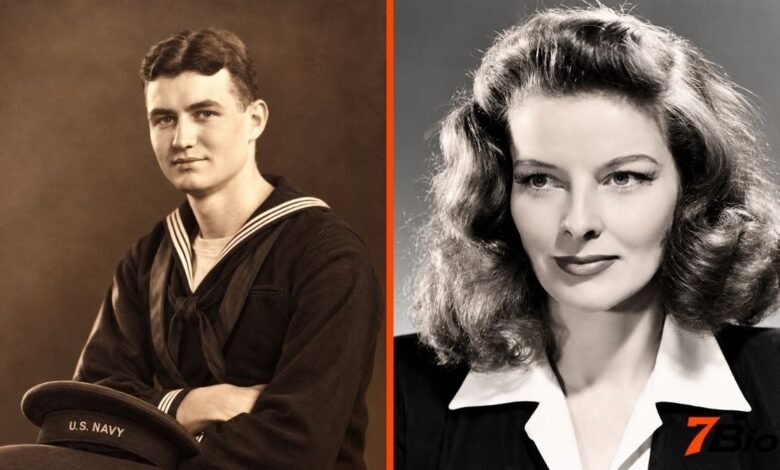
Ludlow Ogden Smith was an American businessman, financial innovator, and former husband of legendary Hollywood actress Katharine Hepburn. Their marriage, which lasted from 1928 until 1934, remains a frequently discussed chapter in Hepburn’s personal history. Yet Smith’s life extended well beyond his connection to one of cinema’s most celebrated performers.
Born in 1899 into a prominent Pennsylvania family, Smith pursued business interests, helped with financial administration, and served in the United States Navy during World War II. He was also known as Ogden Ludlow, a name he adopted during his marriage to Hepburn and retained afterward.
His story offers an interesting view of early twentieth-century American society, professional ambition, and a marriage that developed into a lasting friendship.
This article examines Smith’s background, business achievements, military service, relationship with Katharine Hepburn, and the historical records that preserve his story.
Quick Bio
| Detail | Information |
|---|---|
| Full Name | Ludlow Ogden Smith |
| Also Known As | Ogden Ludlow, Luddy |
| Born | 1899 |
| Died | 1979 |
| Nationality | American |
| Profession | Businessman, financial innovator |
| Education | University of Pennsylvania; studies in Grenoble, France |
| Military Service | United States Navy |
| Military Rank | Captain |
| Known For | Business career and marriage to Katharine Hepburn |
| First Wife | Katharine Hepburn (1928–1934) |
| Notable Business Role | President of Ogden Ludlow Inc. |
Who Was Ludlow Ogden Smith?
Smith came from an established Philadelphia family and built a business career before and after his brief marriage to Katharine Hepburn.
Contemporary accounts often describe him as a Philadelphia insurance broker, while materials associated with the Katharine Hepburn Museum identify him as president of Ogden Ludlow Inc. and creator of a financial processing method called the Ludlow Formula.
Although his marriage brought him wider public recognition, his professional and military experiences distinguish him from someone remembered solely because of a famous spouse.
His name also appears in historical accounts under different forms. Some publications identify him as Ludlow Ogden Smith, while others refer to him as Ogden Ludlow or S. Ogden Ludlow. These variations reflect a name change during his marriage, not separate individuals.
Early Life and Family Background
Ludlow Ogden Smith was born in 1899 to Lewis Lawrence Smith and Gertrude Gouverneur Clemson Smith. The family had established connections in Pennsylvania society, particularly in the Philadelphia region.
The American Philosophical Society’s archival collection identifies Ludlow as the second of three sons. His brothers were Lewis Gouverneur Smith and Lawrence Meredith Clemson Smith.
The family’s papers provide a valuable record of its social and professional history, helping distinguish documented information about Ludlow from details repeated without evidence in celebrity biographies.
Smith received his education at the University of Pennsylvania and also studied in Grenoble, France. These educational experiences preceded his later business career and military service.
His background placed him within a community where professional achievement, family connections, and social responsibility played visible roles. However, his later life demonstrates that his activities were not confined to Philadelphia society.
Business Career and the Ludlow Formula
Smith’s business activities deserve attention in their own right.
Historical newspaper accounts describe him as an insurance broker, while material released in connection with the Katharine Hepburn Museum identifies him as the president of Ogden Ludlow Inc.
He is also credited with developing the Ludlow Formula, which the museum describes as an early approach to financial processing before the widespread introduction of computerized systems in financial institutions.
This detail provides a more substantial picture of his professional identity than descriptions that portray him as simply a businessman or socialite.
Financial institutions in the first half of the twentieth century relied heavily on manual calculations, structured records, and administrative procedures. Systems designed to organize such work formed part of the broader development of modern financial administration.
The museum’s account associates Smith with this field of innovation. Nevertheless, the precise technical operation of the Ludlow Formula and its commercial adoption are not extensively explained in the available historical summaries.
It would therefore be misleading to describe him as the inventor of modern banking technology or attribute later computerized innovations directly to his work.
What can reasonably be established is that his professional interests included business management and financial methods, providing an important dimension to his biography.
Military Service During the Second World War
A notable part of Smith’s life occurred during the Second World War.
According to the American Philosophical Society’s archival description of the Smith family papers, he joined the United States Navy in 1942.
He later rose to captain and held several procurement-related positions in Washington, D.C.
Procurement was a significant administrative function during wartime. Military organizations needed coordinated systems to obtain equipment, materials, and services to support operations.
Smith’s documented involvement in this area demonstrates a professional contribution outside his civilian business career.
His military service also adds a historical perspective often missing from shorter accounts focused entirely on his marriage.
Although the available archival summary does not provide a complete account of every assignment, it establishes his naval service, senior rank, and work in procurement.
How He Met Katharine Hepburn
Smith met Katharine Hepburn in 1927, while she was studying at Bryn Mawr College in Pennsylvania.
Hepburn was approaching the beginning of a remarkable acting career. She graduated from Bryn Mawr in 1928 and soon became involved in professional theatre.
Smith came from a socially prominent Pennsylvania family, while Hepburn had grown up in Connecticut in a household that valued independence, education, and public engagement.
Historical materials associated with Hepburn describe Smith as a kind, generous, and intellectually engaging companion.
The relationship developed as Hepburn made important decisions about her professional future.
Her interest in theatre grew more serious, and opportunities in New York would soon demand considerable commitment.
Smith’s involvement in her life during these early years became an important part of the personal history she later discussed in interviews and autobiographical writing.
Their Marriage in December 1928
Ludlow Ogden Smith and Katharine Hepburn married on December 12, 1928.
The ceremony took place in the living room of Hepburn’s parents’ home in Hartford, Connecticut, with family members present.
It was a relatively intimate occasion rather than an elaborate public celebration.
The wedding has continued to attract historical interest partly because of Hepburn’s distinctive choice of clothing.
She wore a cream-coloured velvet dress created by the Parisian fashion house Babani, featuring decorative gold embroidery.
The garment later became part of the historical record surrounding her life.
In 2004, Sotheby’s included the dress in an auction connected with Hepburn’s estate, documenting its relationship to the 1928 wedding.
The Katharine Hepburn Museum subsequently acquired the garment in 2024, adding another tangible connection to Smith and Hepburn’s marriage.
Why Did Ludlow Ogden Smith Change His Name?
One of the more unusual details of the marriage involves Smith’s name.
Historical accounts, including a 1952 TIME magazine profile and a 1991 Los Angeles Times interview with Hepburn, describe how he changed his name to Ogden Ludlow.
The change was connected to Hepburn’s dislike of the prospect of being called Kate Smith.
Rather than asking Hepburn to adopt a surname she disliked, Smith changed his own name.
Although this detail is sometimes presented as a humorous anecdote, it is supported by accounts of Hepburn’s life and their relationship.
The American Philosophical Society’s archival description also confirms that he retained the name Ogden Ludlow after the divorce.
Consequently, researchers examining historical material about his later career may encounter either version of his name.
Why Did Katharine Hepburn and Smith Divorce?
Their marriage ended in 1934, approximately six years after the wedding.
By then, Hepburn’s acting career had grown significantly. She had made her film debut in A Bill of Divorcement in 1932 and won her first Academy Award for Morning Glory.
Her growing professional commitments increasingly shaped her personal circumstances.
Biographical accounts describe a marriage affected by the demands of Hepburn’s theatrical and Hollywood career.
The couple spent long periods apart, and their different priorities ultimately contributed to the relationship’s breakdown.
Hepburn later spoke candidly about how she treated Smith, acknowledging his generosity and the support he provided while she established herself professionally.
Such reflections offer a more reliable understanding of the marriage than attempts to assign motives based on unsubstantiated stories.
Their divorce ended the marriage, but not their personal connection.
A Friendship That Continued After Divorce
One of the most distinctive aspects of Smith and Hepburn’s relationship was the friendship that continued after their separation.
Accounts published by The Washington Post, Sotheby’s, and the Katharine Hepburn Museum describe the two maintaining a close relationship in later years.
Hepburn recognized Smith’s generosity and the help he offered during an uncertain stage of her career.
In her autobiography, Me: Stories of My Life, she spoke of him with deep affection and gratitude.
The museum’s historical account also indicates that Hepburn remained connected to Smith’s family and visited him during periods of illness.
Their enduring friendship illustrates why their relationship cannot be understood simply through the dates of their marriage and divorce.
Smith shaped Hepburn’s early personal and professional development, and that history remained meaningful long after they stopped being husband and wife.
His Later Marriage and Family Life
After divorcing Hepburn, Smith eventually remarried.
The American Philosophical Society’s family archive identifies his later wife as Elizabeth Albers and records that they had two children.
This establishes that his family life continued beyond the marriage most commonly associated with his name.
The archive also confirms that he retained the name Ogden Ludlow.
Biographical summaries focused exclusively on Hepburn sometimes overlook this later chapter, creating an incomplete impression of his personal history.
For readers researching Smith outside the actress, the family archive offers particularly useful information about his later life.
His later family members did not share Hepburn’s degree of celebrity, so their personal lives do not require unnecessary public examination.
His Death and Historical Legacy
Smith died in 1979, according to the American Philosophical Society’s archival records.
His historical legacy is connected to several different areas: business, wartime military administration, family history, and his relationship with Katharine Hepburn.
While his name appears frequently in discussions of Hollywood history, these other dimensions make his story more complete.
His business leadership and association with the Ludlow Formula show professional activity beyond celebrity circles.
His naval service represents another substantial contribution documented in the family papers.
Meanwhile, his marriage to Hepburn has remained part of cultural history because of her extraordinary career and the autobiographical reflections she later published.
The preservation of wedding materials, family correspondence, and archival descriptions lets historians and interested readers examine these aspects of his life without relying on invented biographical details.
Why People Still Search for Ludlow Ogden Smith
Interest in Smith is closely tied to Katharine Hepburn’s continued popularity.
Hepburn remains an influential figure in American cinema, celebrated for her performances, independence, and unusually long career.
Readers researching her personal history naturally encounter her only marriage and want to understand who she married before she became an established Hollywood star.
Others are interested in Smith’s business career, name change, and military service.
His historical identity is especially interesting because it crosses several subjects: Hollywood history, Philadelphia society, financial administration, and Second World War service.
The preservation of Hepburn’s wedding dress has also given museums and cultural institutions new opportunities to explain the couple’s history through surviving objects.
These documented connections offer meaningful reasons to study Smith as an individual rather than treating him merely as a footnote in another person’s biography.
Privacy, Accuracy, and Historical Records
Information about historical figures can become distorted when biographical websites repeat claims without identifying their original basis.
For Smith, archival collections and established historical publications provide firmer evidence than unsourced discussions of wealth, personality, or private circumstances.
The American Philosophical Society’s family records are particularly valuable for his education, military service, and later family history. Museum documentation and historical reporting help establish the details of his relationship with Hepburn.
A responsible account should distinguish those recorded facts from claims that cannot be independently established.
Conclusion
Ludlow Ogden Smith lived a life that extended far beyond his brief marriage to Katharine Hepburn. His business work, involvement in finance, military service, and later family life reveal a more substantial historical figure than a simple celebrity-relationship label suggests.
His marriage to Hepburn remains an important part of his story, particularly because their friendship continued after divorce. Surviving records also document his independent career and contributions.
Together, these details present a fuller account of Ludlow Ogden Smith as a businessman, naval officer, and figure connected to an important period in American cultural history.
Read this too: Shekinah Pugh: The True Story of Zachary Levi’s Sister
FAQs
1. Who was Ludlow Ogden Smith?
Ludlow Ogden Smith was an American businessman and former naval officer who married actress Katharine Hepburn in 1928 and remained married until 1934. He was also associated with Ogden Ludlow Inc.
2. When did Ludlow Ogden Smith marry Katharine Hepburn?
He married Katharine Hepburn on December 12, 1928, in a family ceremony at her parents’ home in Hartford, Connecticut. They divorced in 1934.
3. What did Ludlow Ogden Smith do for a living?
He worked in business and was described as an insurance broker. Historical museum material also identifies him as president of Ogden Ludlow Inc. and creator of the Ludlow Formula. He served in the U.S. Navy during World War II.
4. Why did Katharine Hepburn’s husband change his name?
Smith changed his name to Ogden Ludlow because Hepburn disliked being called Kate Smith. Historical accounts confirm that he retained his adopted name after their divorce.
5. Did Katharine Hepburn and Ludlow Ogden Smith remain friends after their divorce?
Yes. Historical accounts and Hepburn’s autobiographical reflections confirm that they remained friends after their marriage ended. Hepburn continued to express affection and gratitude for his support during her early career.