Zecway: How Its AI Search Platform Aims to Simplify Company Knowledge
A closer look at the workplace search, source-backed answers, permission controls, and automation features behind this emerging business software.

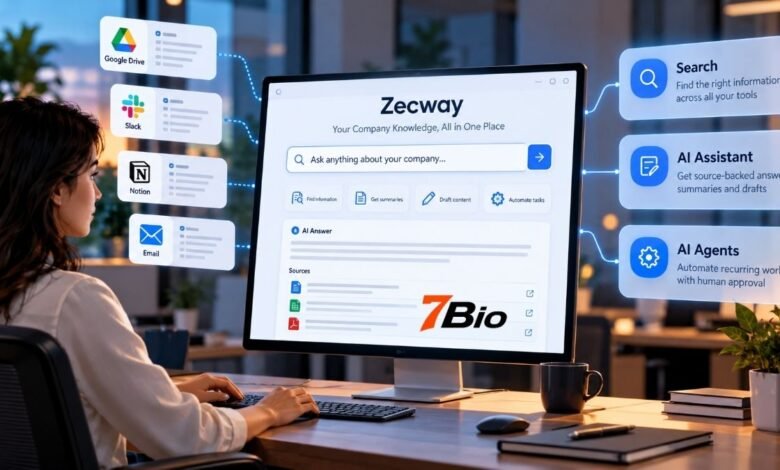
Zecway is an emerging AI-powered workplace search platform that helps employees find information scattered across company documents, conversations, and business applications. Instead of searching multiple systems individually, it brings relevant organizational knowledge into one searchable experience, with answers linked to their sources.
The platform is presented as more than a conventional search engine. Its broader vision combines enterprise search, an AI assistant and task-oriented automation, allowing employees to move from finding information to preparing work and eventually completing routine processes.
As of October 2026, the service is being promoted through an early-access program. Its published materials explain what the platform intends to offer, but independent performance testing, comprehensive technical documentation, and details on general commercial availability remain limited.
For businesses considering AI tools, the key question isn’t simply whether a system can produce a convincing answer. It is whether that answer is accurate, based on authorized company information, traceable to its source, and useful enough to support everyday decisions.
What Is Zecway?
Zecway is a workplace knowledge platform that makes information stored across business applications easier to discover and use. Its current product positioning focuses on giving teams a central search interface rather than requiring employees to remember which application contains a particular document, conversation, or decision.
A typical organization may store contracts in shared drives, project discussions in messaging platforms, operational notes in documentation tools, and important customer correspondence in email. Although these systems work individually, employees can struggle to locate information when the full context is distributed across several places.
The platform proposes to address that problem through connected search and AI-generated responses. Its company description references systems such as Google Drive, Slack, Notion, and email, although onboarding should confirm the availability and configuration of individual integrations.
The central idea is straightforward: employees should be able to search company knowledge without repeatedly switching between disconnected tools.
That doesn’t mean replacing the organization’s existing software. The intended value comes from making information within those systems more accessible through a shared discovery interface.
How Does Zecway Work?
The service describes a three-layer approach involving search, assistance, and agents. These components represent different levels of interaction with business information.
1. Unified Search Across Workplace Tools
The first layer centers on retrieving relevant company information from connected sources.
Consider an employee trying to locate the latest approved pricing presentation. They might ordinarily search a shared drive, review team messages and ask a colleague whether the document has changed.
A unified search experience could bring those information sources together, helping the employee identify the relevant file and supporting discussion.
Zecway describes its search as responsive and source-aware. Its promotional material claims an answer time of about 0.4 seconds, but this should not be treated as an independently established performance benchmark.
Actual speed would need to be assessed with realistic company data, connected applications, and typical employee queries.
2. AI Assistance Grounded in Company Information
The second layer goes beyond finding a document. It is intended to help employees draft responses, prepare summaries and interpret relevant information.
For example, a sales employee preparing a client proposal might need information from product specifications, previous correspondence and internal policies.
An AI assistant with authorized access to those sources could assemble a draft while identifying the materials used to support its statements.
This approach is commonly described as grounded AI assistance, meaning that generated responses are supported by retrieved information rather than relying only on a model’s general knowledge.
However, source references do not automatically guarantee that an answer is correct. A system can retrieve an outdated document, overlook an exception, or misinterpret relevant context.
Human verification therefore remains important, especially for contractual, financial, or sensitive business decisions.
3. AI Agents for Workflow Automation
The third layer focuses on more involved tasks.
The company’s presentation describes agents that can conduct research and prepare actions within recurring workflows. It also shows an approval step before posting information to a workplace communication channel.
For example, a team might want a recurring summary of changes across project documents and conversations. An appropriately configured agent could potentially prepare the information for review before distribution.
The distinction between automated preparation and autonomous execution matters. Businesses should define which actions are available today, which are still under development, and which require explicit human approval.
A promotional demonstration is not sufficient evidence that every illustrated workflow is available to all users.
Main Features and Their Practical Value
Several capabilities explain why Zecway may interest organizations exploring workplace AI solutions.
Source-Backed Answers
The platform emphasizes citing the documents or conversations used to construct an answer.
This matters when employees need to verify an important statement rather than accept a generated response without supporting evidence.
A useful implementation should let users identify the source, inspect its context, and determine whether the material remains current.
Permission-Aware Information Retrieval
One of the product’s central claims concerns access control.
Its published description states that permissions are enforced before the AI system provides information, so employees should receive only results they are authorized to view.
In principle, this helps preserve distinctions between departments and roles. Someone with access to a finance document might receive relevant results, while another employee without permission should not.
This is a meaningful design objective, but businesses should request technical evidence and test their own access scenarios before relying on it.
Natural-Language Search
Traditional workplace search often depends on remembering a filename, a precise phrase, or a document location.
Natural-language search offers a different method. Employees can ask a question, such as where a policy was discussed or which document contains the approved project requirements.
The potential benefit is easier discovery, especially for people who do not know the organization’s document structure.
Workflow Support
The planned combination of search, drafting and agents may reduce the number of separate steps involved in information-heavy work.
Employees could potentially find background material, prepare a summary and arrange a follow-up activity within a more connected process.
The practical benefit depends on the reliability of integrations, the quality of retrieved information, and the controls governing automated actions.
Who Could Benefit From the Platform?
The company’s public positioning identifies businesses with approximately 30–500 employees as a target market. That range helps define its intended audience, although it does not establish a formal eligibility requirement.
A growing company often reaches a point where organizational knowledge becomes difficult to locate. More employees create more documents, more conversations, and more fragmented decision records.
Several teams could have reasons to investigate a connected search system.
Operations teams frequently need policies, process descriptions and status updates from different departments. A central discovery interface could reduce time spent locating routine information.
Sales and customer-facing teams may need current product explanations, approved commercial material, and historical account context. Source-backed retrieval could help them prepare more consistent responses.
Human resources teams work with policies and internal guidance, although confidential employee records would require particularly careful access controls.
Project managers and leadership teams may benefit from quicker access to decisions, progress reports, and documents without relying entirely on individual colleagues to find them.
These are potential applications, not independently demonstrated outcomes for every organization.
Zecway Compared With Traditional Workplace Search
The difference between conventional search and an AI-assisted knowledge platform is best understood by examining what each is intended to do.
| Area | Traditional Workplace Search | Proposed AI Workplace Approach |
|---|---|---|
| Finding information | Searches documents or messages in a particular system | Searches across supported connected sources |
| Search input | Often depends on filenames or keywords | Allows questions in natural language |
| Results | Usually returns files or message matches | May provide an answer with source references |
| Preparing content | Requires separate drafting work | AI assistance may help prepare drafts and summaries |
| Workflow actions | Generally separate from search | Agents may support connected tasks |
| Access control | Depends on each application’s permissions | Claims to respect permissions during retrieval |
These differences describe the general approaches rather than a controlled comparison of product performance.
A business already using sophisticated search features within Microsoft 365, Google Workspace or another integrated environment should compare existing capabilities before adding a separate platform.
Another system is valuable only when it resolves a genuine gap in the organization’s workflow.
Security, Privacy and Reliability Considerations
Security is one of the most important areas to examine before connecting workplace AI software to business systems.
Company documents may contain confidential contracts, customer records, financial information, employee details and commercially sensitive discussions.
Zecway publicly emphasizes permission-aware retrieval, but permission handling is only one element of a broader security assessment.
Before deployment, an organization should establish how authentication works, which permissions it requests, how it processes connected data, and whether access changes are reflected correctly when employees change roles.
It should also ask whether the provider retains company information, uses it for model training, transfers it to subprocessors, or processes it in particular geographical regions.
For UK businesses, data protection considerations may become especially relevant when personal information is involved. Processing arrangements should be reviewed against applicable UK GDPR obligations.
Evaluate security documentation, contractual protections, incident response processes, and independent assurance where appropriate. A marketing statement about keeping data secure is not a substitute for such evidence.
Accuracy deserves similar attention. Even when every generated claim includes a citation, employees still need to recognize outdated records, contradictory policies, and incomplete supporting material.
The safest approach is to treat AI search as a discovery and assistance tool, not an unquestionable authority.
Pricing and Availability in 2026
As of October 2026, Zecway’s public website promotes limited early access rather than displaying a conventional list of subscription packages.
The sign-up invitation requests a work email address and indicates that no credit card is required for the early-access request.
This does not mean future paid plans will be free or that every applicant will get immediate access.
Businesses interested in the platform should confirm the current onboarding process, product functionality, user limits, supported integrations, and any eventual subscription costs directly with the provider.
It is also worth asking whether access includes technical support, administrator controls, and help configuring permissions.
Without published commercial terms, a reliable price comparison against established enterprise search products is not yet possible.
Understanding the Zecway Name and Earlier Business Listings
Another distinction is worth recognizing when researching this name.
Some older public business listings identify Zecway as a creative and marketing business, including references to Zecway Studio LLP in Bengaluru, India.
Meanwhile, the current Zecway website presents an AI-focused workplace knowledge product.
These records reflect different descriptions associated with the name. They should not automatically be combined into a single corporate history without confirmation of the legal and commercial relationship.
Anyone assessing the software for procurement purposes should establish which legal entity provides the service, who enters into the contract, and which organization is responsible for processing customer data.
This verification becomes particularly important when older directory listings and current marketing materials describe different business activities.
How to Evaluate Zecway Before Adoption
A sensible evaluation starts with a defined business problem, not the assumption that another AI platform will automatically improve productivity.
Identify the Knowledge Problem
Start by identifying information employees regularly struggle to locate. These might include approved documents, project decisions, onboarding policies, or current product guidance.
A realistic sample of recurring questions creates a more meaningful test than a generic software demonstration.
Confirm Integration Requirements
List the systems that hold the information your team actually needs.
Check whether each system is supported, whether synchronization is available, and what happens when source documents are updated or removed.
Test Accuracy and Permissions
Use a controlled pilot with non-sensitive or appropriately authorized material.
Include questions with straightforward answers, ambiguous wording and contradictory documents. Confirm whether the system points to the correct source and acknowledges uncertainty when the evidence is incomplete.
Permission testing should involve users with different access levels.
Evaluate Workflow Capabilities Separately
Do not assume that search, AI drafting and autonomous agents are equally mature.
Ask for demonstrations of the exact tasks your organization intends to use, including approval controls and failure handling.
Assess Practical Value
The final decision should consider whether employees find information more effectively, whether answers remain dependable, and whether the system adds administrative or security work.
A small, structured pilot is often more informative than broad claims about time savings.
Challenges and Limitations
Zecway’s concept addresses a recognizable workplace problem, but several limitations deserve consideration.
First, the publicly available materials provide more information about the product’s intended capabilities than independently documented deployment results.
Second, a connected knowledge system depends heavily on the condition of the underlying records. Duplicate documents, outdated policies, and unclear permissions can reduce result quality.
Third, AI-generated summaries may omit qualifications or misunderstand relationships between sources, even when citations are available.
Finally, adopting another platform creates an additional vendor relationship. Organizations must consider ongoing costs, integration maintenance, support quality, data portability, and procedures for ending the service.
These considerations do not mean the product is unsuitable. They explain why early-access software deserves a careful and evidence-based evaluation.
FAQs
1. What is Zecway used for?
Zecway is presented as an AI-powered workplace knowledge platform designed to help employees find information across connected company tools. Its broader vision includes source-backed AI assistance and workflow automation.
2. Is Zecway free to use?
Its public website offers an early-access registration process without requiring a credit card. That does not confirm permanent free usage, and available public information does not include detailed future subscription pricing.
3. Does Zecway support Google Drive and Slack?
The company’s public description mentions Google Drive, Slack, Notion, and email among the workplace information sources it aims to connect. Organizations should verify each integration’s availability and requirements before adoption.
4. Is Zecway safe for confidential business information?
The company promotes permission-aware retrieval, but that claim alone does not establish comprehensive security assurance. Businesses should review technical documentation, contractual protections, and actual permission behavior before connecting confidential information.
5. Can Zecway automate business tasks?
Workflow automation is part of the product’s described direction, including AI agents and human-approved actions. A demonstration should confirm the precise capabilities currently available to early-access users.
6. Is Zecway suitable for small companies?
The company’s stated target audience includes teams of approximately 30–500 people. Smaller businesses may still find the concept relevant, but suitability depends on their information systems, available functionality, security requirements, and cost.
Final Takeaway
Zecway represents an emerging approach to workplace knowledge management: connecting information discovery, AI-generated assistance and potential workflow automation within a common experience.
Its emphasis on source-backed answers and permission-aware retrieval addresses key concerns for organizations considering enterprise AI. Employees need to find reliable information without accidentally exposing confidential records or relying on unsupported answers.
The opportunity is clear, but organizations should interpret the evidence carefully. The current public materials establish the product’s positioning and early-access offering; they do not independently prove universal performance, security compliance, or measurable productivity gains.
For businesses investigating the platform, the most productive next step is a controlled evaluation using genuine workplace questions, realistic permissions, and clear success criteria.
The value of any enterprise AI system ultimately depends not on how impressive its demonstrations appear, but on whether it makes everyday work more accurate, accessible and dependable.