
tr-ex.me: What Happened to the Contextual Translation Website in 2026?
A closer look at the bilingual translation platform, its most useful features, reported accessibility problems, and practical alternatives for language learners.

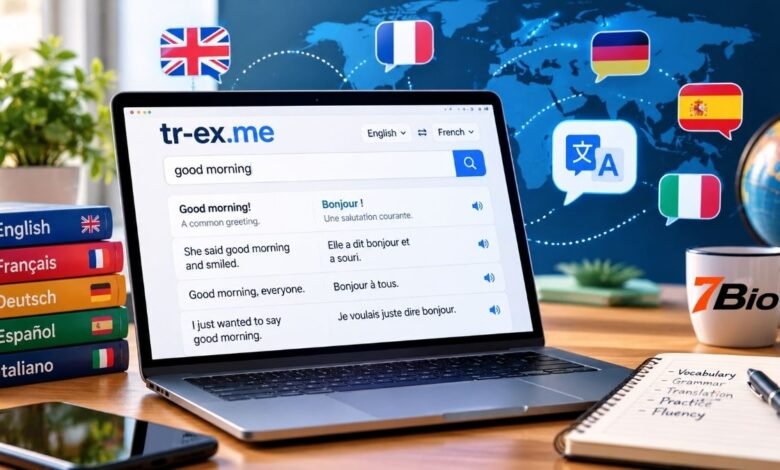
Finding the right translation is not always as simple as replacing a word in one language with another. A phrase that sounds perfectly natural in English may require completely different wording in French, German, Spanish, or another language. That difficulty made tr-ex.me an appealing resource for learners and translators seeking examples of expressions used in complete sentences.
Unlike a conventional dictionary that concentrates on definitions, the platform focused on contextual translation. It displayed translated sentence pairs, letting users compare possible meanings, recognize expressions, and see how words behaved in different situations. Its collection of multilingual examples made it especially relevant to people learning to communicate beyond textbook vocabulary.
However, the website’s accessibility became a significant concern during 2026. Language learners reported difficulties reaching the service, while independent website monitoring indicated prolonged periods of unavailability. As of October 2026, evidence suggests ongoing access problems, although no verified official announcement has confirmed a permanent closure.
This guide examines the platform’s original purpose, how its translation approach worked, what is known about its reported downtime, and the alternatives that can help readers continue learning languages through examples.
What Is tr-ex.me?
tr-ex.me was an online bilingual contextual dictionary designed to help people understand translations through natural-language examples. Instead of presenting only one translation for a word or expression, it displayed several possible equivalents alongside sentences illustrating their usage.
The service drew on collections of previously translated material, including dialogue, documents, and multilingual website content. This approach was useful because meaning often depends on the surrounding words, subject matter, and conversational situation.
Consider the English expression “take off”. In one sentence, it can describe an aircraft leaving the ground. In another, it means removing clothing. It can also describe a business experiencing rapid success. A straightforward dictionary may list these meanings, but translated examples show how each meaning works within a complete sentence.
That was the service’s central attraction. Rather than treating vocabulary as a collection of disconnected definitions, it encouraged users to examine how words relate to their surrounding context.
How Did tr-ex.me Work?
The platform operated as a searchable collection of bilingual examples. A user could enter a word or short phrase, select an available language combination, and review sentences containing the expression alongside their translations.
The platform generated translation suggestions algorithmically from existing translated examples. Importantly, human editors did not check every result individually. That distinction meant the service was valuable for discovering possible translations but could not guarantee that every example was correct.
Searching Words and Expressions
The search process focused on everyday vocabulary and phrases. Instead of requiring complex commands, users could look up expressions they encountered while reading, studying, or translating.
For example, someone researching the phrase “break the ice” would need to distinguish its figurative meaning, making a social situation more comfortable, from its literal meaning involving frozen water.
A context-based dictionary can help by displaying sentences where an expression appears in different circumstances. Readers can then identify which meaning fits their own writing or conversation.
Comparing Multiple Translations
Another useful aspect of tr-ex.me was its presentation of alternative translations. Different expressions can sometimes communicate similar meanings, but their tone, formality, or grammatical requirements may vary.
A phrase suitable for an informal conversation might sound inappropriate in a business letter. Similarly, a literal translation may be understandable but not sound natural to a native speaker.
Comparing examples helps learners identify these distinctions, although careful judgment is still necessary. A frequently displayed translation is not automatically the most appropriate one.
Learning Through Complete Sentences
Individual vocabulary items become more meaningful when learners see how they connect with other words. Complete sentences can reveal verb patterns, prepositions, common word combinations, and the difference between formal and conversational language.
This is particularly helpful for expressions whose meanings cannot be understood by translating every component separately.
However, example-based learning works best when learners also understand basic grammar. Repeatedly copying expressions without checking their grammar can lead to mistakes.
Why Was tr-ex.me Useful for Language Learners?
One reason people valued the platform was its ability to connect textbook knowledge with practical language usage. Traditional dictionaries are essential for understanding definitions, but they cannot always explain which expression sounds most natural in a particular situation.
Contextual examples help address that problem by showing how vocabulary appears in conversations and written material.
Understanding Idioms and Everyday Speech
Idiomatic expressions can be difficult because their meanings aren’t always obvious from the individual words.
The phrase “under the weather”, for instance, usually means feeling unwell rather than physically standing beneath a particular weather condition.
A direct word-for-word translation may fail to convey that meaning. Studying equivalent expressions in another language provides a better starting point for understanding how native speakers communicate similar ideas.
This makes contextual examples especially useful for informal dialogue, stories, films, and ordinary conversation.
Improving Vocabulary Retention
Learning vocabulary through sentences can also support understanding and recall. A word tied to a meaningful situation is easier to interpret than an isolated item on a long list.
Students can use translated examples to identify recurring expressions, practice constructing sentences, and compare how similar meanings are expressed.
A practical approach is to collect a small number of useful examples, study their grammar, and create new sentences using the same patterns.
The objective should be to understand how language works, not to memorize translations without context.
Supporting Independent Translation Work
For translators, contextual resources can help reveal possible wording choices that may not appear in a conventional dictionary entry.
This is particularly useful when a phrase has several meanings or a text contains informal language.
Nevertheless, published translation work requires independent verification. A collection of automatically matched examples cannot replace subject knowledge, careful editing, or professional judgment.
What Happened to tr-ex.me in 2026?
Accessibility problems became a major part of the website’s story in 2026.
On 9 April 2026, a discussion in an online language-learning community described the website returning a 403 Forbidden response. Other users subsequently reported similar difficulties accessing the service.
Independent website-status monitoring also recorded extended periods of unavailability during 2026. By October, monitoring still showed the service was not consistently reachable.
A direct attempt to retrieve the website during research for this guide also failed.
These observations support the conclusion that the service experienced serious accessibility problems. However, they do not independently establish exactly why those problems occurred.
Does a 403 Error Mean a Website Has Closed?
Not necessarily.
An HTTP 403 response means a server is refusing access to the requested resource. This can happen because of permissions, security restrictions, traffic filtering, or other server configurations.
A separate gateway error or connection timeout can reflect different technical problems.
None of these errors alone proves that a website has permanently shut down. Establishing a permanent closure would require more reliable information, such as an official announcement or clear evidence that the operator had discontinued the service.
Is the Website Permanently Gone?
As of 13 October 2026, the available evidence supports describing tr-ex.me as reportedly inaccessible for an extended period, rather than declaring a definitively confirmed permanent shutdown.
This research found no verified official explanation.
Users should therefore avoid treating speculation about hosting costs, legal disputes, ownership changes, or financial difficulties as confirmed reasons for the interruption.
The distinction matters because an accurate account should separate observed technical problems from assumptions about their causes.
Important Limitations of Contextual Translation
Even when the platform was accessible, its translation approach had limitations that readers needed to understand.
Because example collections may combine subtitles, websites, official documents, and other materials, their quality can vary considerably.
A sentence translated for a film may prioritize conversational meaning over literal wording. A sentence from an official document may use terminology that sounds unnatural in everyday speech.
The automated matching process can introduce additional problems.
Translation examples are evidence of possible usage, not guaranteed recommendations. Some may contain awkward wording, incorrect matches, outdated expressions, or differences between the highlighted source phrase and the translated text.
Users should also consider regional language differences. British English, American English, European Spanish, and Latin American Spanish may express similar ideas differently.
A reliable learning process involves checking grammar, considering the context, and comparing multiple trustworthy references when accuracy matters.
Best Alternatives to tr-ex.me in 2026
People who previously relied on tr-ex.me have several useful alternatives. Although none reproduces every aspect of the original service, different platforms offer contextual examples, traditional dictionary entries, translation assistance, or language-learning resources.
| Platform | Main Strength | Best Suited For |
|---|---|---|
| Reverso Context | Translations alongside contextual examples | Idioms, phrases and everyday expressions |
| Linguee | Bilingual dictionary entries with translated text examples | Written translation and terminology |
| Tatoeba | Community-maintained multilingual sentence collection | Sentence practice and language learning |
| WordReference | Dictionary entries and detailed language discussions | Vocabulary, grammar and usage questions |
| DeepL | Machine translation of words and longer passages | Draft translations and text comprehension |
| Google Translate | Translation across a broad range of languages and formats | Everyday translation and quick language assistance |
Reverso Context
Reverso Context is one of the best alternatives for people who prefer translation examples over isolated dictionary entries.
It displays multiple possible translations and examples drawn from translated texts. Users can examine different expressions and filter examples to understand specific meanings.
The platform also offers additional language-learning functions, depending on the language and interface.
Its main limitation is familiar to users of contextual dictionaries: examples may contain errors, unsuitable wording, or expressions that do not fit every situation.
Linguee
Linguee combines dictionary-style translation information with examples from bilingual texts. This makes it particularly helpful when comparing terminology or understanding how expressions appear in written documents.
People working with formal writing, technical vocabulary, or business-related material may find this approach useful.
However, examples drawn from particular documents may not reflect ordinary conversation. Users should consider the subject and writing style before adopting a translation.
Tatoeba
Tatoeba is a collaborative collection of sentences and their translations. Its focus on complete sentences helps learners see vocabulary in practical use.
The project supports multilingual learning and allows contributors to improve its collection.
Its community-driven structure is a strength, but not every sentence or translation receives the same degree of verification. Learners should check questionable examples against another reference.
WordReference
WordReference provides bilingual dictionary resources and language discussion forums covering vocabulary, idioms, grammar, and usage.
Its forums can be particularly useful when a translation involves a subtle distinction or an expression without an obvious equivalent.
Unlike a general translation engine, a dictionary and discussion-based service can explain why particular wording is appropriate.
DeepL and Google Translate
DeepL and Google Translate serve somewhat different needs. They are primarily useful for generating translations rather than simply exploring collections of matched sentences.
Both can help readers understand unfamiliar text, but they should still check automatically generated output before using it for important work.
Google introduced additional context-focused translation assistance in parts of its service during 2026, although availability depends on the feature, region, and platform.
Readers who previously depended on tr-ex.me for studying expressions may find a translation engine alongside a contextual dictionary more useful than relying on either tool alone.
A Practical Method for Finding Natural Translations
Replacing an unavailable translation resource does not require choosing one website for every task. A more reliable approach combines several methods based on the phrase’s complexity.
Step 1: Identify the intended meaning. Before searching, decide whether the expression is literal, idiomatic, technical, formal, or conversational.
Step 2: Check a contextual dictionary. Search the phrase in Reverso Context or another example-based resource and compare several relevant sentences.
Step 3: Verify important vocabulary. Use a reputable dictionary to confirm definitions, grammar, and differences between similar expressions.
Step 4: Examine regional usage. Consider which country, audience, or language variety the translation is intended for.
Step 5: Test the expression in a complete sentence. Read the proposed translation in context and check that the meaning remains accurate.
Step 6: Request qualified review when necessary. Legal documents, medical information, contractual wording, and other high-impact material may require a trained translator or subject specialist.
This method provides a more dependable process than choosing the first translation you see.
Can Contextual Translation Improve Writing Skills?
Contextual translation can support writing development when used actively rather than as a copying tool.
A student writing in another language can compare several examples to understand sentence structure, common combinations, and natural expression.
For example, English speakers usually say “make a decision” rather than “do a decision”. Other languages may use different verb-and-noun combinations to communicate the same idea.
Studying these patterns helps learners move beyond translating individual words.
The value comes from recognizing how expressions function within a sentence and applying that understanding to new situations.
It is equally important to avoid copying long passages from example databases into published work. Translation examples are useful learning references, but they do not automatically provide permission to reproduce copyrighted material.
How to Avoid Misleading Translation Websites
When a familiar service becomes inaccessible, users may search for replacement websites, archived pages, or similarly named domains.
Before using an unfamiliar platform, check that it clearly states its purpose and doesn’t promise guaranteed translation accuracy.
Be cautious about downloading unknown software or installing browser extensions that request unnecessary permissions.
Do not enter passwords, confidential business documents, private correspondence, or sensitive personal information into translation services without reviewing how that information may be processed.
These precautions apply whether a website has recently experienced technical difficulties.
For students, typical vocabulary searches usually raise fewer privacy concerns than uploading full private documents. Professional users should follow their organization’s data-handling rules.
FAQs
1. What was tr-ex.me mainly used for?
It was mainly used to find translations of words and phrases, along with bilingual sentence examples. Its contextual approach helped language learners understand possible meanings, idioms, and everyday expressions.
2. Is tr-ex.me working in October 2026?
Independent monitoring and user reports indicate prolonged accessibility problems during 2026. This research also could not retrieve the website. Availability may change, and a permanent shutdown has not been conclusively confirmed.
3. Was the platform free to use?
Historical descriptions classified it as a free online translation resource. Its ordinary search functionality was accessible without a paid subscription. We cannot verify current access conditions while the site remains inaccessible.
4. Which alternative is most similar to the original service?
Reverso Context is a close functional alternative because it provides bilingual translation examples and helps users compare expressions across different contexts. Linguee and Tatoeba may also suit particular learning needs.
5. Can contextual translation replace a professional translator?
No. Contextual examples can support vocabulary research and improve understanding, but they cannot guarantee that a translation is accurate, culturally appropriate, or suitable for specialized documents. Important material may require professional review.
6. What should students use to improve translation accuracy?
Students can combine example-based resources with traditional dictionaries, grammar references, and writing practice. Comparing several translations and understanding the intended meaning is more productive than copying a single result without checking it.
Final Takeaway
tr-ex.me offered a useful approach to language learning by connecting translations with real sentence examples. Its appeal came from helping readers see how words and expressions can change meaning depending on context.
The website’s reported accessibility problems in 2026 created uncertainty for people who relied on it. Although the evidence points to extended downtime, the precise cause and whether the interruption was permanent remain unconfirmed.
For learners seeking comparable resources, Reverso Context, Linguee, Tatoeba, and WordReference provide different ways to examine vocabulary and translation examples. DeepL and Google Translate can complement those resources when you need to translate an entire text.