Siemless Explained: How Modern Security Teams Detect and Respond to Cyber Threats
Understand SIEM-less security architecture, intelligent threat detection, security automation, and how it differs from traditional SIEM platforms.

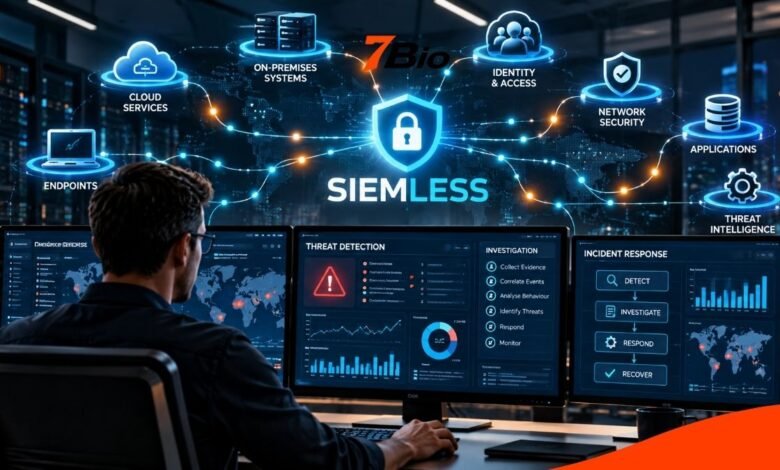
SIEMless describes cybersecurity approaches that reduce reliance on traditional, centralized Security Information and Event Management (SIEM) platforms. Rather than requiring every security event to pass through a large central logging system before investigation, these approaches may analyze threats closer to their source, connect evidence from different security tools, and automate parts of the investigation process.
This approach has gained attention as organizations manage security information across cloud services, employee devices, business applications, and complex networks. Security teams need to identify suspicious activity quickly while retaining enough evidence to understand incidents and make responsible decisions.
However, moving toward a SIEM-less model doesn’t mean abandoning security logs or automatically achieving better protection. The real question is whether a different architecture can improve detection, investigation, and response without sacrificing visibility, accountability, or reliability.
What Is Siemless in Cybersecurity?
The term siemless, usually written as SIEMless or SIEM-less, broadly refers to security monitoring models that don’t rely entirely on a conventional, centralized SIEM workflow.
A traditional SIEM collects security information from multiple systems, processes that data, and helps analysts identify potentially malicious activity. It can provide a searchable event history, detection rules, alerts, dashboards, and evidence for investigations.
A SIEM-less approach aims to deliver some or all of those security outcomes through a different arrangement of technologies.
For example, an organization might detect suspicious behavior directly on an endpoint, correlate identity and cloud events through an investigation platform, and retain detailed records in a separate storage system.
The critical distinction is that SIEM-less does not necessarily mean logless. Organizations still need enough records to investigate security incidents, determine what happened, and meet relevant obligations.
Is SIEMless a Standard Technology or a Product?
The name does not refer to a single, universally accepted architecture.
Different cybersecurity companies use SIEM-less terminology to describe different products and operating models. BluSapphire describes its SIEM-less offering as an AI-first, distributed SIEM architecture. SenseOn uses the term to describe an investigation-led approach that can retain existing security controls. ReliaQuest announced GreyMatter SIEM-Less in July 2026, describing a model that prioritizes detection before storage and offers flexibility in where security data is retained.
These differences matter. Two platforms using similar language may have very different capabilities, licensing arrangements, and technical requirements.
The term should also not be confused with SEIMless Communications, which operates in enterprise communications and networking.
How Does SIEMless Security Work?
The underlying principle is to separate security outcomes from unnecessary dependence on one central processing system.
Although implementations differ, these architectures commonly include several components.
1. Security Data Collection
Monitoring begins with information generated by devices, applications, identities, networks, and cloud services.
Examples include authentication attempts, administrator actions, suspicious processes, unexpected configuration changes, and unusual network connections.
A well-designed SIEMlessSIEM environment identifies which events require immediate detection and which records must be preserved for future investigation.
Collecting less information without understanding its value can create dangerous gaps. Effective design therefore starts with the threats an organization needs to detect.
2. Detection at the Source
Some newer security platforms analyze events where they are generated or while they move through a data pipeline.
For instance, endpoint software might identify suspicious command execution before the associated event reaches long-term storage.
This design can reduce the need to transfer every raw event into a single analytical database before taking action.
However, source-based detection requires dependable software deployment, adequate computing resources, and reliable communication between systems.
3. Event Correlation and Context
An isolated alert may reveal only part of an attack.
An unusual login could be harmless. The same login, followed by unexpected privilege changes and access to sensitive files, may warrant investigation.
Modern detection platforms connect related signals into coherent incidents, helping analysts understand activity rather than review hundreds of unrelated notifications.
Correlation may rely on predefined rules, behavioral analysis, statistical techniques, or machine learning.
4. Investigation and Response
Once analysts identify suspicious activity, they need context to determine whether an incident is genuine.
A system may assemble affected accounts, relevant devices, event timelines, and supporting evidence.
Response actions can include raising a ticket, isolating a compromised endpoint, or requesting account deactivation.
High-impact actions should have appropriate approval controls. Automated decisions can be incorrect, and an unnecessary shutdown may disrupt legitimate business operations.
SIEMless vs Traditional SIEM: Key Differences
Understanding the architectural differences helps organizations distinguish meaningful innovation from marketing terminology.
| Area | Traditional SIEM | SIEM-less Approach |
|---|---|---|
| Data processing | Often relies on central collection and analysis | May analyse events at source, in transit, or across distributed systems |
| Detection | Uses rules, correlation, analytics, and increasingly AI | May emphasise distributed detection and contextual investigation |
| Storage | Frequently integrates analytical storage | May separate storage from detection and investigation |
| Investigation | Often centred on SIEM searches and incident views | May combine evidence from multiple security tools |
| Automation | Available through SIEM features and integrations | May place greater emphasis on integrated response workflows |
| Costs | Depend on licensing, ingestion, retention, and infrastructure | Depend on the specific architecture, integrations, storage, and service model |
Neither approach is automatically superior.
Modern SIEM platforms already support sophisticated analytics, automation, and cloud integration. Some SIEM-less products also retain functions traditionally associated with SIEM systems.
The meaningful comparison is therefore not simply old versus new. The key question is whether the proposed architecture performs the organization’s necessary security tasks more effectively.
Potential Benefits of Seamless Security
Faster Threat Investigation
A major potential advantage is reducing delays between detecting unusual activity and presenting useful evidence to an analyst.
When security teams analyze relevant signals early and assemble them into a single incident view, they may spend less time searching across disconnected systems.
Actual improvements depend on network conditions, detection quality, system integration, and the organization’s existing tools.
More Flexible Data Management
Centralized security platforms can require substantial resources for data ingestion, indexing, and retention.
A distributed approach may let businesses process key signals immediately while storing selected records in systems that match their retention and investigation needs.
This flexibility can be particularly valuable when data originates across multiple cloud services or geographical environments.
However, reducing data transfers should never mean discarding records needed for forensic analysis.
Reduced Alert Fatigue
Security analysts can struggle when systems generate large numbers of low-priority notifications.
Contextual correlation may help by grouping related activities into fewer, more meaningful investigations.
A useful, seamless implementation should let analysts understand why alerts were combined, which events contributed to the conclusion, and what additional evidence remains available.
Simply hiding alerts is not enough.
Improved Operational Flexibility
Organizations often invest in endpoint protection, identity management, cloud monitoring, and incident response platforms.
An investigation-led architecture may bring information from these tools together without requiring immediate replacement of every existing component.
This can support gradual modernization and reduce unnecessary disruption, provided the integrations are reliable.
Important Limitations and Security Risks
Assess the benefits of seamless technology alongside its limitations.
Loss of Security Visibility
If a platform filters or discards information too aggressively, investigators may later discover that essential evidence is unavailable.
This becomes particularly problematic when malicious activity remains unnoticed for an extended period.
The UK’s National Cyber Security Center recommends proportionate logging and emphasizes the importance of preserving access to relevant records during investigations.
Integration Complexity
Distributed security tools may use different data formats, permissions, timestamps, and reporting methods.
Connecting these systems requires careful configuration and maintenance.
A platform that promises unified visibility must demonstrate that it can handle incomplete information, disconnected services, and integration failures.
Dependence on Automated Analysis
AI-assisted tools may misclassify legitimate activity, overlook unusual attacks, or produce misleading incident summaries.
Human oversight remains important, especially when a response could disconnect critical systems or affect business operations.
Security teams should also retain clear evidence supporting automated recommendations.
Compliance and Audit Requirements
Organizations operating in regulated sectors may have specific responsibilities concerning event retention, security monitoring, and audit evidence.
Replacing a traditional SIEM does not remove these responsibilities.
Before adopting SIEM-less solutions, businesses should define which records to preserve, how long to keep them, and who can access them.
Where Can SIEM-Less Security Be Useful?
Cloud-Based Businesses
Companies operating across multiple cloud environments may struggle to manage security events through a single conventional logging pipeline.
Distributed monitoring can help connect cloud alerts, identity events, and workload activity into a broader investigation.
The advantage depends on comprehensive integration and reliable access to historical evidence.
Organizations With Limited Security Resources
Smaller security teams may benefit from systems that prioritize important incidents and reduce repetitive investigation tasks.
Nevertheless, automation cannot replace security ownership, incident response planning, or regular system maintenance.
A small organization might also find a managed security service or appropriately configured conventional SIEM more practical.
Large Enterprises
Enterprises frequently operate extensive networks with multiple business units, infrastructure providers, and security platforms.
A seamless architecture may offer greater flexibility in handling data from these environments.
The potential benefit must be balanced against migration complexity, contractual requirements, existing investments, and the need for central oversight.
How to Evaluate a Seamless Platform Before Adoption
Purchasing a solution based only on claims about artificial intelligence or reduced costs is insufficient.
A structured evaluation should focus on actual security outcomes.
Step 1: Identify Required Detection Capabilities
Document the attacks and suspicious behaviors the organization must recognize.
These may include compromised user accounts, malicious software execution, unexpected administrative changes, and unauthorized data access.
Assess whether the proposed platform supports the necessary data sources and detection techniques.
Step 2: Examine Data Retention
Determine which records remain available after processing.
Confirm how information is stored, protected against alteration, retrieved, and exported during an investigation.
The absence of an expensive central database is useful only when evidence remains accessible when needed.
Step 3: Test Investigation Workflows
Evaluate the platform using authorized, controlled security exercises.
Check whether analysts can identify the affected systems, reconstruct events, and explain the evidence supporting an alert.
A useful evaluation measures both detection performance and investigation quality.
Step 4: Review Automation Safeguards
Understand which actions occur automatically and which require human approval.
Confirm that the platform records response decisions, allows appropriate intervention, and safely handles erroneous alerts.
Step 5: Compare Total Operating Costs
A meaningful comparison includes licensing, data processing, storage, deployment, integration, training, support, and ongoing administration.
Treat vendor projections of dramatic savings as claims until you verify them against the organization’s requirements.
Step 6: Run a Controlled Pilot
Where practical, operate the proposed system alongside existing monitoring tools during evaluation.
This allows the security team to compare visibility, detection coverage, alert quality, and operational reliability before making a major change.
Common Mistakes Businesses Should Avoid
One frequent mistake is assuming that replacing centralized log analysis eliminates the need for historical records. Attack investigations often require events that seemed harmless when they were first generated.
Another mistake is treating vendor terminology as a technical standard. Different products may use seamless language while delivering substantially different services.
Businesses should also avoid relying solely on AI-generated conclusions, overlooking integration failures, or permitting automated containment without appropriate safeguards.
Finally, moving to a new security architecture without clear success criteria makes it difficult to determine whether the change has genuinely improved protection.
The Future of SIEM-Less Cybersecurity
Modern security operations are driving increased interest in flexible data pipelines, distributed detection, behavioral analytics, and integrated investigation tools.
ReliaQuest’s July 2026 announcement of GreyMatter SIEM-Less illustrates this direction, while BluSapphire and SenseOn’s offerings show vendors pursuing different technical and operational approaches.
Traditional SIEM systems are also evolving. Modern platforms increasingly incorporate cloud-native processing, intelligent correlation, and automated response capabilities.
The future may therefore involve a mixture of centralized and distributed technologies rather than the complete disappearance of SIEM.
Organizations are likely to focus less on product labels and more on practical outcomes: dependable threat detection, accessible investigation evidence, manageable operational costs, and effective incident response.
FAQs
1. What does seamless mean?
It describes a cybersecurity approach that reduces dependence on a conventional centralized SIEM platform. Different vendors implement the concept through distributed detection, alternative data processing, or investigation-focused security operations.
2. Does SIEM-less security eliminate logs?
No. Security logs remain essential for understanding incidents, verifying activity, and supporting investigations. The architecture changes how records are collected, analyzed, or stored, but it doesn’t necessarily eliminate them.
3. Is SIEM-less the same as XDR?
Not necessarily. Extended Detection and Response (XDR) is a security technology category that combines detection and response information across multiple environments. SIEM-less approaches may include XDR capabilities, but the terms aren’t interchangeable.
4. Can businesses use SIEM-less tools alongside existing security platforms?
Yes, some vendors specifically support integration with existing SIEM, endpoint protection, identity management, and ticketing systems. Confirm compatibility for each deployment.
5. Is a SIEM-less system always cheaper than a traditional SIEM?
No. Cost depends on licensing, data volume, storage, integration, operational support, and the organization’s security requirements. Savings are possible, but you should demonstrate them through realistic comparisons.
6. Should every organization replace its current SIEM?
No. A well-managed SIEM may already meet an organization’s needs. Replacement or modernization should follow a security assessment, technical evaluation, and clear business justification.
Final Takeaway
Siemless represents an evolving approach to cybersecurity that questions whether all threat detection and investigation activity needs to depend on a traditional centralized SIEM architecture.
Distributed analysis, intelligent event correlation, flexible data management, and automation can offer practical advantages. Yet those benefits depend on reliable integrations, sufficient evidence retention, appropriate human oversight, and careful implementation.
The best security architecture helps an organization detect, understand, and respond to real threats while maintaining accountability and operational control. Businesses should evaluate measurable capabilities rather than choosing a technology simply because it carries a newer name.