Amcoder: A Practical Guide to Coding Challenges, Features, and Software Engineering Skills
Understanding how structured programming challenges, transparent scoring and engineering-focused practice can support technical learning.

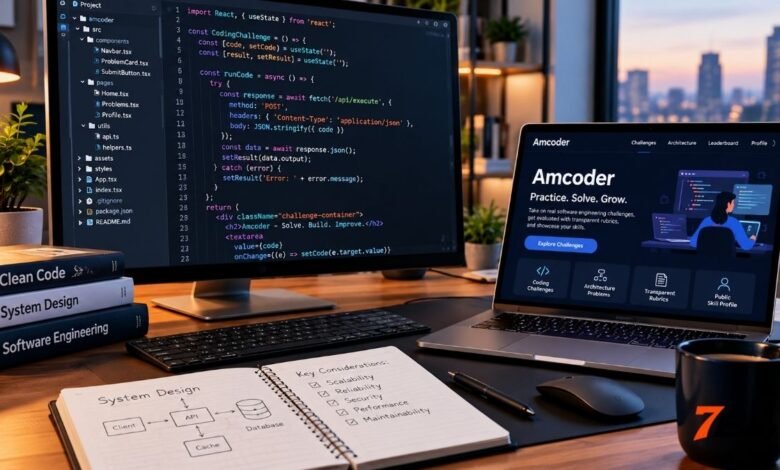
Amcoder is a technology-related name most commonly associated with an online platform focused on practical software engineering challenges. Rather than simply presenting programming lessons, the platform currently describes an approach in which participants choose technical problems, work through timed sessions, and receive assessments based on published criteria. The results are intended to contribute to a public record of their technical abilities.
For aspiring developers, this approach raises an interesting question: can structured problem-solving provide a more useful picture of software engineering skills than completing tutorials alone?
The answer depends on the quality of the exercises, the assessment methods, and how learners use the feedback. Understanding these factors is essential before choosing any technical learning platform.
This guide explains the platform’s publicly described approach, its potential educational value, key limitations, and how similarly named technology organizations differ.
What Is Amcoder?
Amcoder is a software engineering practice platform that emphasizes solving technical problems and assessing the resulting work. Its current website describes coding and architecture challenges, timed problem-solving sessions, published scoring rubrics and public profiles that record assessed results.
The concept is relatively straightforward. Participants are encouraged to demonstrate their understanding by completing technical tasks rather than relying exclusively on passive lessons or theoretical descriptions.
A programming exercise might involve producing working code, explaining a design decision, or considering how software components interact. Architecture exercises may require a different approach, concentrating on requirements, trade-offs and the reasoning behind a proposed solution.
These examples illustrate the skills engineering assessments can evaluate. They should not be interpreted as a confirmed catalog of specific exercises currently available on the platform.
Several unrelated technology businesses use names resembling AmCoder. Therefore, you need to identify the correct organization when researching its services.
How Does the Platform Work?
The official website outlines a process centered on selecting problems, completing focused sessions, and receiving structured evaluations.
1. Choosing a Technical Problem
The first stage involves selecting a coding or software architecture problem from the platform’s published collection.
A useful engineering problem should establish what needs to be achieved, which constraints apply, and how the result will be assessed. Clear requirements help participants understand what a successful solution must accomplish.
For beginners, the exercise’s difficulty matters. A task involving unfamiliar programming concepts may reveal knowledge gaps but can also become frustrating without suitable preparation.
More experienced developers may find greater value in challenges that require architectural reasoning, performance considerations, or managing competing technical requirements.
2. Completing a Focused Session
The platform describes timed working sessions in which it records the participant’s approach and written explanation.
Timed practice introduces an additional constraint: a developer must decide how to use the available time.
In professional software development, technical decisions rarely involve unlimited resources. Engineers must balance requirements, implementation effort, and the need to deliver dependable results.
However, performing well under a timer is not the same as performing well on a production engineering team. Real projects also involve collaboration, research, testing, changing requirements, and longer development cycles.
Timed challenges are therefore best understood as one way to observe technical problem-solving, rather than a complete measure of professional capability.
3. Receiving a Rubric-Based Assessment
A notable feature Amcoder describes is evaluation against a published rubric.
A rubric establishes criteria used to assess a response. Depending on the technical problem, criteria might focus on correctness, clarity, design reasoning, error handling, or the ability to explain trade-offs.
Published criteria can help participants understand what the assessment values before they begin.
The platform states that it can add scored results to a public profile. Nevertheless, the exact weighting, consistency, and practical validity of its assessments would need closer examination before anyone treated the resulting scores as authoritative measures of engineering ability.
Why Rubric-Based Coding Assessment Matters
A single correct answer can’t always capture programming ability.
Two developers might produce different implementations that satisfy the same requirements. One solution may be shorter, another easier to maintain, and a third better suited to handling a larger workload.
A well-designed assessment should consider the qualities relevant to the problem rather than rewarding complexity for its own sake.
Making Evaluation Criteria Understandable
Transparent scoring allows learners to see which qualities matter.
For example, an exercise might value functional correctness alongside the explanation of important implementation choices. Knowing these expectations encourages developers to think beyond making a program run once.
The value of transparency also depends on whether the rubric itself is appropriate. Clearly published criteria help, but publication alone does not automatically ensure every score is fair or accurate.
Encouraging Better Engineering Decisions
Software development involves selecting approaches that fit specific circumstances.
A small internal application may not require the same architecture as a heavily used commercial service. Choosing unnecessary components can increase maintenance costs without delivering meaningful benefits.
Technical practice becomes more useful when learners can explain why they selected a particular solution, which alternatives they considered, and what limitations remain.
That reasoning is often as important as the code itself.
Identifying Areas for Improvement
Assessment feedback can highlight subjects that deserve further study.
A participant might discover that their implementation produces the expected output but lacks suitable error handling. Another might explain the overall architecture convincingly while overlooking important requirements.
The next learning step should follow the actual weakness.
This turns assessment into a practical improvement process rather than treating every result as a final judgment of someone’s ability.
What Skills Can Engineering Challenges Help Develop?
Structured challenges can support several aspects of technical development, provided the exercises and feedback are sufficiently relevant.
Programming and Logical Reasoning
Programming requires translating a problem into a sequence of instructions that a computer can execute.
Useful practice includes breaking larger requirements into manageable components, choosing suitable data structures, and anticipating edge cases.
Repeated exercises may help developers recognize familiar patterns and become more confident explaining their solutions.
That improvement still depends on thoughtful practice. Completing many nearly identical exercises does not necessarily demonstrate readiness to handle unfamiliar production systems.
Software Architecture and System Design
Architecture concerns how different parts of an application fit together.
Developers must consider data storage, component communication, reliability, and the consequences of different design choices.
In an illustrative scenario involving an online booking application, a developer might need to explain how reservations are stored, how the system handles simultaneous requests, and what happens when a dependent service becomes unavailable.
There may be several reasonable answers.
The quality of the reasoning depends on the requirements, constraints, and assumptions, not on including fashionable technologies.
Technical Communication
Writing an explanation of a solution can reveal whether a developer understands the decisions they have made.
Clear technical communication helps colleagues review code, identify risks, and maintain software after the original author moves on to another task.
A useful explanation identifies the problem, the chosen approach, relevant alternatives and known limitations without unnecessary jargon.
Who Might Benefit From Amcoder?
The platform’s stated approach may appeal to different groups, but its suitability depends on the actual exercises and assessment experience.
Students and aspiring software engineers may appreciate a structured opportunity to apply knowledge acquired through coursework or independent study. Completing a challenge can reveal the difference between recognizing a programming concept and applying it independently.
Self-taught developers may find task-based practice useful when deciding which subjects to revisit. Feedback can provide direction, especially when participants understand the reasons behind an assessment.
Early-career professionals may benefit from rehearsing technical explanations and practicing decisions under constraints. Describing trade-offs is useful in code reviews and technical discussions.
Experienced engineers could potentially use more demanding exercises to reflect on architecture and implementation choices. However, check the existence and depth of suitable advanced challenges rather than assuming them.
What Makes Coding Challenges Different From Tutorials?
Tutorials and assessed exercises serve different purposes.
A tutorial typically explains a concept and demonstrates an approach. A challenge asks the learner to apply their understanding to a defined problem.
| Learning method | Main purpose | Important limitation |
|---|---|---|
| Guided tutorials | Introduce concepts and techniques | Following instructions may conceal knowledge gaps |
| Independent coding projects | Build complete applications | Feedback and assessment may be inconsistent |
| Timed coding challenges | Practise focused problem-solving | Time pressure may not reflect normal development |
| Rubric-based assessments | Evaluate work against stated criteria | Score quality depends on the rubric and its application |
| Collaborative development | Build communication and teamwork | Difficult to reproduce fully through solo exercises |
The strongest learning routine often combines these methods.
A developer might first study a concept, try an independent challenge, review the outcome, and then apply that knowledge in a larger project.
This sequence connects theory with practice.
How to Make Coding Practice More Effective
People exploring Amcoder or a similar technical practice platform can use a simple improvement cycle.
Begin With an Appropriate Difficulty Level
Choose problems that require genuine thought without making every essential concept unfamiliar.
If a problem introduces too many new ideas at once, study the foundations before attempting a more advanced exercise.
Read the Requirements Carefully
Before writing code, identify the expected inputs, outputs, constraints, and possible failure conditions.
Rushing into implementation without understanding the requirements often creates avoidable mistakes.
Plan Before Implementing
Outline the intended solution, relevant components, and important assumptions.
A short plan can reveal design problems before they become expensive to correct.
Review More Than the Final Score
A score may summarise an assessment, but the reasons behind it are usually more educational.
Consider whether the solution meets the requirements, handles relevant edge cases, and remains understandable to another developer.
Revisit the Weakest Area
Use any meaningful feedback to select the next learning activity.
If the principal weakness concerns data handling, practice that skill rather than immediately moving to an unrelated subject.
Evaluation becomes easier when each exercise has a clear learning objective.
Important Limitations and Questions to Consider
Despite the potential value of structured coding practice, several practical questions deserve attention.
The first concerns assessment reliability. A published rubric explains the standards, but it does not independently establish the scoring process’s consistency or accuracy.
The second concerns problem quality. Exercises need clear requirements, appropriate difficulty, and sufficient context to produce useful evaluations.
The third involves public profiles. Developers should understand which submissions, descriptions, or assessment results may become publicly accessible. Developers should never submit confidential employer code, private credentials, or proprietary information without proper permission.
Developers should also check cost and availability. The homepage describes free access to begin exploring problems, but that statement alone does not establish that every feature or future activity is permanently free.
During the October 2026 review, the homepage’s problem-listing area displayed an error message. As a result, that page could not independently establish the full available challenge catalog.
These limitations do not prove that the service is unsuitable. They identify matters a prospective participant should verify before relying on it.
Amcoder vs AmCodr and AmcoderZ: Understanding the Differences
One source of confusion is the similarity between several independent technology names.
Organization Publicly described focus Main distinction
AmCoder Software engineering challenges and structured assessment A practice-oriented platform
AmCodr IT Solutions Website, web application and mobile application development A software development services business
AmcoderZ Infotech Custom software, mobile applications, web development and IoT solutions A business-focused technology services provider
AmCodr IT Solutions describes itself as an Indian technology company established in 2016. It focuses on delivering software services to clients.
AmcoderZ Infotech also operates in software development, including applications, connected-device solutions and business software.
These organizations should not be treated as departments of the same company merely because their names resemble one another.
For users, the distinction is practical. Someone searching for engineering exercises has different requirements from a company seeking developers to build a commercial application.
Confirming the official domain, organization details, and service description helps prevent confusion.
How Should You Evaluate the Platform Before Signing Up?
A sensible evaluation begins with the problems you want to solve.
If your objective is to build programming confidence, check whether the available exercises match your language, experience, and interests.
If you are interested in system design, check whether the challenges provide meaningful architectural scenarios rather than superficial questions.
Next, examine the evaluation criteria. A useful rubric should make its expectations understandable and relevant to the exercise.
Finally, consider the experience’s ongoing value. A platform is more useful when participants can learn from mistakes and apply what they discover elsewhere.
A public assessment record may supplement a developer’s portfolio, but it should not replace demonstrable project experience, readable code, collaborative ability or professional judgment.
FAQs
1. What is Amcoder used for?
Amcoder is currently described as a platform for practicing software engineering through coding and architecture challenges. Its published approach includes timed sessions, rubric-based assessment, and public records of assessed work.
2. Is Amcoder suitable for beginners?
It may be useful for beginners who already understand the fundamental concepts required by an exercise. New learners should check problem difficulty and available guidance before deciding whether it matches their current abilities.
3. Is Amcoder free to use?
The website advertises a free starting experience and says visitors can explore its catalog without creating an account. Confirm the full pricing terms and whether individual features are available directly.
4. Can coding assessment results help with employment?
Assessment results may provide additional evidence of technical practice. However, their value to employers depends on the assessment’s credibility and relevance. They do not guarantee interviews, employment or recognition of a particular skill level.
5. Are AmCoder and AmcoderZ the same company?
No reliable evidence reviewed shows they are the same organization. Their websites describe different activities: one focuses on technical practice, and the other on software development services.
Final Takeaway
Amcoder represents an approach to software engineering practice built around completing technical challenges and having the results assessed against stated criteria.
Its most interesting principle is the connection between doing technical work, explaining decisions, and receiving structured evaluation. That combination can support learning when the exercises are relevant, and the feedback is dependable.
Still, no single platform can establish every dimension of professional engineering ability. Practical projects, independent study, collaboration, and continual improvement remain essential.
For anyone considering the service, the best starting point is to verify the available challenges, examine the scoring rules, and decide whether the experience addresses a genuine gap in their technical development.