hmjones.net: A Clear Guide to Its Purpose, Content, and Reliability
Understanding the business-finance publication, its ownership disclosures, and an unexpected connection to a fiction author.

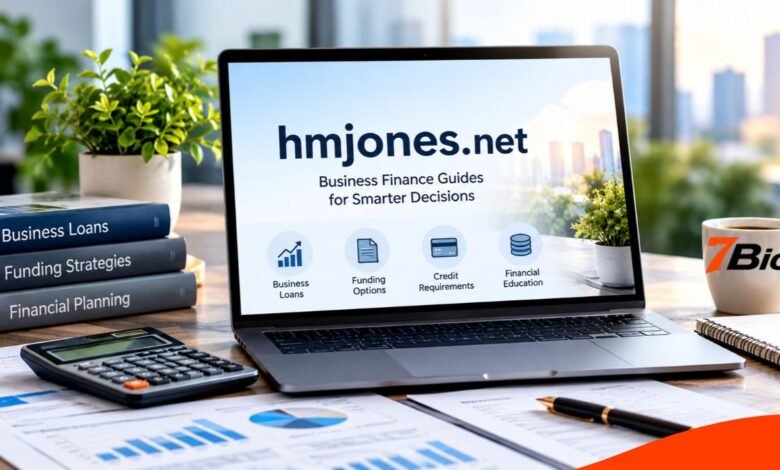
The website hmjones.net features business-finance educational content on small-business loans, borrowing requirements, credit, and funding options. Its indexed pages describe an informational publication designed to help entrepreneurs understand financing concepts before approaching financial institutions. However, another detail is worth noting: the domain also appears on an older online profile belonging to fiction author H.M. Jones.
These two associations can confuse anyone researching the website’s purpose, history, or reliability. A financial-information publication and an author’s website serve completely different audiences, and public records do not confirm any connection between their current operations.
Understanding this distinction helps readers evaluate what the domain actually represents, how its published information might be useful, and which claims deserve further verification.
This article examines the website’s documented content, declared publisher, historical author association, and practical reliability considerations. It also explains how visitors can use financial education responsibly without mistaking general information for professional lending advice.
What Is hmjones.net?
According to its indexed homepage and About page, hmjones.net presents itself as an educational journal covering business loans and small-business funding. It aims to explain financing concepts in accessible language for entrepreneurs, business owners, and people exploring commercial borrowing.
The publication is organized around several familiar financing subjects, including loan products, interest rates, business credit, application requirements, and borrowing scenarios. Rather than concentrating on a single financial product, its articles attempt to explain different stages of the borrowing process.
This distinction matters because providing educational information is not the same as issuing loans. The website’s published description does not establish that it operates as a bank, licensed lending institution, or loan broker. Its stated role is informational.
For a business owner who is unfamiliar with borrowing terminology, an introductory guide can provide useful context. It may explain the difference between a secured loan and an unsecured loan, why lenders ask for financial documents, and how businesses can compare repayment structures.
Nevertheless, an educational website cannot independently determine whether a particular financing arrangement suits an individual business.
What Type of Information Does the Website Publish?
The indexed content suggests the publication is structured around practical questions small-business borrowers commonly ask.
Business Loan Fundamentals
One section introduces core borrowing concepts, such as the types of business loans available and the differences between installment and revolving credit.
These distinctions affect how businesses receive funds, repay balances, and calculate borrowing costs. A term loan generally involves a set amount and repayment schedule, while a revolving credit facility may let eligible borrowers access funds repeatedly within set limits.
Understanding these structures can help business owners identify which questions to ask a prospective lender. However, contract terms vary by provider and jurisdiction.
Loan Requirements and Application Preparation
Another major subject is the documentation commonly requested during a business loan application.
The site’s indexed article library includes material about credit scores, qualification requirements, financial statements, and documentation. These topics matter because lenders typically assess repayment capacity, financial history, and the purpose of the proposed borrowing.
Depending on the lender and product, business owners may need to prepare accounting records, bank statements, tax information, and legal documents.
An informational guide can help readers understand these requirements, but it should not be treated as an authoritative checklist for every provider.
Interest Rates and Financing Costs
The publication also discusses business loan rates and related borrowing expenses.
This area requires particular care. Interest rates can change with market conditions, lender policies, the applicant’s circumstances, repayment duration, and the financial product being considered.
A rate mentioned in an educational article may be illustrative, historical or applicable only to certain borrowers. It should never be assumed to represent a current offer.
When comparing loans, examine the total repayment amount, interest calculation, fees, security requirements, and potential penalties rather than focusing solely on an advertised rate.
Funding for Specific Business Situations
The website’s indexed article titles also cover financing scenarios for construction businesses, limited liability companies, startups, and other commercial situations.
These topics can be useful because borrowing needs vary considerably between industries. A contractor waiting for customer payments faces different financial pressures from a startup purchasing equipment or an established retailer expanding its stock.
The practical value of such guidance depends on whether its explanations reflect the reader’s industry, jurisdiction, and circumstances.
Who Owns and Publishes hmjones.net?
The indexed About page identifies AXOLOT LLC as the website’s publisher and owner. It provides a Warsaw address and Polish business identification details.
The identifiers published on that page correspond to a Polish company registered as AXOLOT Spółka z ograniczoną odpowiedzialnością. Public company listings identify the business under KRS number 0001117600 and show a registration date of 23 July 2024.
The matching company identifiers provide a useful starting point when examining the publisher’s declared identity.
However, two separate matters must be distinguished. Confirming that a registered company exists is not the same as independently confirming that the company currently controls a particular internet domain.
Likewise, a company’s registration does not automatically establish that its editorial contributors hold professional financial qualifications or that every statement in its articles is correct.
Another minor address detail to check during any formal due diligence: the indexed website disclosure and Polish company listings show different postal-code formats for the Warsaw address.
For ordinary readers, the most relevant takeaway is that publisher transparency is one useful trust signal, not a complete verification of reliability.
The Connection Between hmjones.net and Author H.M. Jones
An unusual aspect of this domain is that it appears on the Goodreads profile of fiction writer H.M. Jones.
The author’s Goodreads page lists the domain as a website address. That profile associates Jones with works including Monochrome and the Attempting to Define poetry series.
A separate author website, hmjoneswrites.com, presents H.M. Jones as a Washington-state writer working across poetry, fantasy, science fiction and speculative fiction.
This creates two distinct public associations: a literary profile linking to the domain and indexed website content centered on business finance.
It would be inaccurate to conclude from those facts alone that the author currently publishes the financing articles, owns the registered company or has any connection to the present editorial operation.
Website addresses can change ownership, purpose or content over time. Profile links can also remain online after they cease to reflect a person’s current activities.
Without authenticated domain-registration history or a direct statement establishing a relationship, describe the author connection as a documented profile association rather than a verified present-day ownership arrangement.
Is hmjones.net a Legitimate and Trustworthy Website?
Evaluating the reliability of hmjones.net requires separating several questions often treated as one.
First, does identifiable content exist? Indexed records show articles covering business financing, loan requirements, and related subjects. The domain therefore has a documented publishing footprint.
Second, does the publication identify an operator? Its About page names a company and provides identification details consistent with public Polish business listings.
Third, is the information independently reliable? We cannot establish that by reviewing article titles, author names, or publisher disclosures alone. Individual financial claims still require checking against authoritative sources.
Finally, is the website technically safe and functioning correctly? Direct attempts to retrieve its homepage and About page during this research timed out. A timeout alone does not prove that a site is malicious, permanently unavailable, or unsuitable for visitors. It does mean that a complete live technical assessment was not possible.
For that reason, there is insufficient evidence here to offer an unconditional safety guarantee or to classify the publication as fraudulent.
A more defensible assessment is that the domain has an identifiable educational-finance presence and a declared publisher. In contrast, its current accessibility, domain control, and the accuracy of individual financial recommendations require separate verification.
How Useful Is the Website for Small-Business Owners?
The main potential benefit of hmjones.net is its focus on explaining financial terminology and borrowing considerations.
New business owners sometimes approach lenders without fully understanding the differences between funding products. This can make it hard to evaluate borrowing costs, assess repayment obligations, or identify questions to resolve before signing an agreement.
Educational material can reduce that knowledge gap, particularly when it explains financial concepts clearly and distinguishes general principles from provider-specific requirements.
For example, a business owner investigating equipment financing may first need to understand whether the arrangement involves a loan, lease, hire purchase or another form of funding. Understanding these distinctions can clarify the next stage of research.
However, information becomes less reliable when it replaces a verified offer or personalized assessment.
A UK business owner should also recognize that finance articles discussing American entities, credit systems, or lending programs may not apply directly to the United Kingdom.
The most useful approach is to read for understanding, identify the concepts relevant to the business and then verify the applicable rules and terms with appropriate sources.
What Should Readers Check Before Relying on Financial Content?
A practical review of an unfamiliar financial publication should focus on more than its appearance or the confidence of its writing.
| Evaluation area | What readers should examine |
|---|---|
| Publisher identity | Whether an identifiable organisation operates the publication |
| Editorial transparency | Whether articles identify authors, dates and relevant qualifications |
| Financial accuracy | Whether important claims are supported by reliable evidence |
| Information freshness | Whether rates, rules and requirements are still applicable |
| Website security | Whether the site uses HTTPS and handles information appropriately |
| Commercial relationships | Whether advertising, sponsorship or referral incentives are disclosed |
| Financial suitability | Whether the guidance applies to the reader’s country and circumstances |
These criteria provide a more balanced assessment than relying entirely on a site’s design, a brief online review or an unverified reputation score.
Financial information deserves particular scrutiny because an inaccurate explanation can influence real borrowing decisions.
Important Limitations Readers Should Understand
The biggest limitation of any general-purpose finance publication is that business lending depends heavily on individual circumstances.
Two companies with similar annual revenue may receive different financing terms because of differences in their credit histories, cash flow, existing liabilities, or business models.
Equally, a loan arrangement described as attractive in a general article may involve conditions that make it unsuitable for a particular borrower.
Readers should also be careful about providing sensitive information. An informational website does not necessarily need access to identification documents, banking credentials or confidential financial records merely to explain a lending product.
If a website redirects visitors to a financing provider, it should make clear which organization will receive their information and whether that organization has the required authorization.
Always assess the reliability of a general explanation and the legitimacy of a specific financial transaction separately.
How to Use hmjones.net Responsibly
The most sensible way to approach the publication is to use it as a possible starting point for research.
Begin by identifying the precise financial question you want answered. This might involve understanding loan security, comparing repayment arrangements, or learning which documents lenders typically request.
Read relevant educational content, separating straightforward definitions from claims that depend on current market conditions.
Next, compare important statements with information published by established financial institutions, relevant regulators or qualified professional advisers.
If you intend to apply for financing, obtain the actual product terms directly from the provider. Confirm the total costs, repayment schedule, fees, eligibility conditions and consequences of missed payments.
Finally, avoid making a borrowing decision based on a single article, regardless of how comprehensive it appears.
This approach lets readers benefit from accessible financial explanations while staying appropriately cautious about money, business obligations, and personal information.
Conclusion
Based on available indexed evidence, hmjones.net is best understood as a business-finance educational website rather than a confirmed direct lending service. Its content focuses on helping entrepreneurs understand borrowing options, financial requirements, and commercial funding concepts.
The website identifies AXOLOT LLC as its publisher, with company details corresponding to public Polish business listings. An older Goodreads author profile also links the domain to fiction writer H.M. Jones, though the available evidence does not confirm any relationship between the author and the finance publication.
The responsible conclusion is neither unconditional endorsement nor unsupported suspicion. The website may provide useful introductory information, but readers should independently verify significant financial claims and avoid relying on its content as personalized financial advice.
FAQs
1. What is hmjones.net used for?
The domain’s indexed content describes an educational website covering business loans, funding options, credit requirements, interest rates, and related financial concepts. It states its audience includes entrepreneurs and small-business owners researching financing.
2. Does hmjones.net directly provide business loans?
The publication describes itself as an educational information resource rather than a direct lender. Available evidence does not show that it approves loan applications or provides funding directly.
3. Who is the owner of hmjones.net?
Its indexed About page identifies AXOLOT LLC as owner and publisher. Matching company identifiers appear in Polish business-register listings, although those records alone do not independently confirm current control of the domain.
4. Is hmjones.net connected to the author H.M. Jones?
Goodreads lists the domain on the author’s profile. However, this association does not prove that the writer operates or owns the business-finance publication. The author’s separate website is hmjoneswrites.com.
5. Is hmjones.net safe and reliable for financial research?
It may be useful for introductory financial education, but you should independently verify its information before letting it influence borrowing decisions. A complete, up-to-date security assessment and live content audit were not possible, so making unconditional safety or accuracy claims would be inappropriate.