DL Evans: The Remarkable Story of David Lloyd Evans and His Lasting Legacy
From early business ventures and public service to founding a banking institution that continues to serve communities more than a century later.

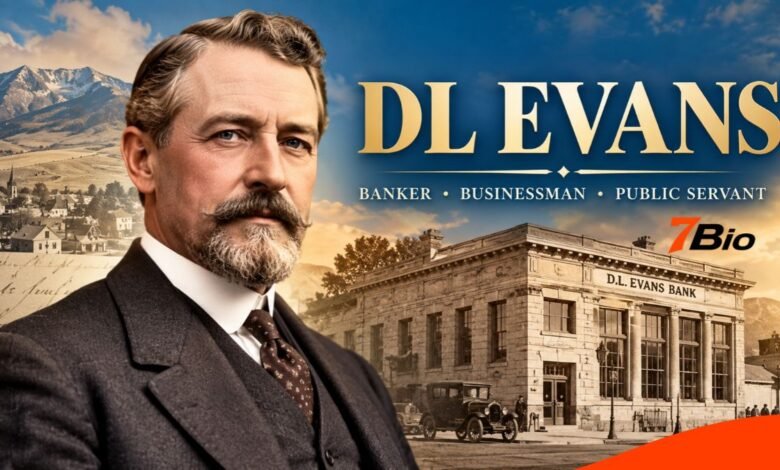
DL Evans, whose full name was David Lloyd Evans, was an American banker, businessman, and public servant who played an important role in southern Idaho’s commercial development. Born on 20 May 1854 in Brigham City, Utah Territory, he became involved in agriculture, retail, finance, and politics before helping establish D.L. Evans Bank in Albion, Idaho, in 1904. His career reflected the changing economic and political landscape of the American West during the late nineteenth and early twentieth centuries.
Although the financial institution bearing his name is more widely recognized today, he had an extensive public and commercial career of his own. He served in territorial and state government, participated in local banking ventures and supported the development of institutions that served growing communities.
His story connects one family’s history to the broader development of Idaho’s economy.
Quick Biography
| Detail | Information |
|---|---|
| Full Name | David Lloyd Evans Sr. |
| Known As | D.L. Evans |
| Date of Birth | 20 May 1854 |
| Birthplace | Brigham City, Utah Territory, USA |
| Date of Death | 12 July 1929 |
| Age at Death | 75 years |
| Nationality | American |
| Occupations | Banker, businessman, politician |
| Father | David Rees Evans |
| Mother | Winnefred (Gwen) Lloyd Roberts Evans |
| Known For | Co-founding D.L. Evans Bank |
| Bank Founded | 1904 |
| Original Bank Location | Albion, Idaho |
| Political Career | Idaho territorial and state legislatures |
| Associated Places | Malad City and Albion, Idaho |
Early Life and Family Background
David Lloyd Evans was born in 1854, as communities across the western United States experienced rapid settlement and agricultural development. His parents, David Rees Evans and Winnefred Lloyd Roberts Evans, belonged to a family whose history included migration from Wales and the challenges of establishing a new life in the American West.
His mother traveled from Wales to the United States in 1850 with her first husband, Daniel L. Roberts, and their children. The journey was marked by the deaths of her husband and one of her sons during a cholera outbreak. She later married David Rees Evans in Utah Territory, and their children included David Lloyd.
The family experienced further hardship when David Rees Evans died in 1861. In 1871, the family relocated to the Malad Valley region of Idaho, where his mother established a homestead.
This move connected the young Evans to the area that would become central to his business and political life. Farming, livestock, trade, and the gradual establishment of more permanent institutions shaped the Malad region.
Historical accounts indicate that he studied at the University of Deseret, the predecessor of the University of Utah, and worked as a schoolteacher. His early involvement in education and agriculture preceded a career that eventually extended into banking and public administration.
Building a Business Career in Idaho
Before becoming associated with his namesake bank, David Lloyd Evans had already established a reputation as a merchant and business leader in the Malad area.
During the nineteenth century, cooperative stores played an important role in many western communities. They provided access to everyday goods, agricultural supplies, and other necessities when transporting merchandise between settlements was expensive and difficult.
In the 1880s, Evans and his brother Lorenzo joined a cooperative business in Malad that became the Evans Co-op. The enterprise became part of the town’s commercial history and contributed to his standing in the local business community.
His activities were not restricted to retail trading. Historical preservation records identify him as president of the J. N. Ireland Bank and the Evans Co-op, demonstrating his involvement in more than one commercial institution.
These businesses operated in a region where agriculture remained central to the economy. Local merchants and bankers often had close relationships with farmers, ranchers, and other business owners who needed access to equipment, supplies, credit, and reliable financial services.
Evans’s commercial interests therefore connected him with several important aspects of regional development.
Political Career and Public Service
Business was only one part of DL Evans’s professional life. He was also active in government during Idaho’s transition from a United States territory to a state.
Historical accounts place his early legislative service in the Idaho Territorial Legislature in 1882, where he represented Oneida County. His public career continued after Idaho achieved statehood in 1890.
In 1899, he served in the Idaho House of Representatives and became Speaker. He later served in the Idaho Senate, gaining experience across different areas of state government.
His responsibilities also extended to education and institutional administration. Historical preservation documentation records his service as president of the Idaho State Board of Education and his involvement with the state institution later known as State Hospital South.
These positions suggest a career that combined practical commercial experience with an interest in public administration.
His involvement in education is particularly notable because teaching had formed part of his early working life. Rather than following a single profession, Evans moved between business, agriculture and public service during a period when local leaders frequently carried several responsibilities.
Founding D.L. Evans Bank in 1904
The most enduring institution associated with David Lloyd Evans began in Albion, Idaho, in September 1904.
He and other southern Idaho business people established a community bank intended to serve the area’s financial needs. The bank’s official history also recognizes his brother, Lorenzo Lloyd Evans, as an important founding figure.
According to its historical account, the institution began with $25,000 in capital and was closely connected to a mercantile business.
Albion was then an important community in Cassia County. As the regional economy developed, farmers, merchants, and local business owners needed financial services. A local bank could provide a practical alternative to conducting transactions through institutions located farther away.
The bank was established on 15 September 1904 and was named after David Lloyd Evans.
Its opening became an important development in the family’s commercial history. Rather than remaining merely a personal business venture, the institution continued operating long after its founder’s lifetime.
In 1910, the bank moved into a two-story stone building in Albion, reflecting its establishment as a more permanent part of the community.
This early development helps explain why the founder’s name remains recognizable today.
His Role in Education and Community Development
DL Evans’s influence extended beyond banking and retail commerce.
His service in legislative and educational institutions placed him among the individuals involved in shaping Idaho’s early public administration. These responsibilities mattered during an era when the state was developing its schools, public services, and government structures.
As a business leader, he also participated in enterprises that contributed to the commercial activity of Malad and nearby settlements.
His career illustrates how local business leaders could become influential figures in public life. Experience gained through agriculture and commerce offered practical knowledge of the economic concerns faced by growing communities.
However, it is important not to attribute every later achievement of the businesses or institutions associated with him directly to his personal decisions. Much of their subsequent development occurred under later leadership.
His documented contributions are substantial without requiring exaggerated claims about his influence.
The Historic Evans Family Residence
One distinctive reminder of David Lloyd Evans’s position in Malad’s history is his former residence.
Malad residents built a substantial bungalow for him in the mid-1910s. The building became notable for its unusual architectural design, expensive construction, and elaborate interior details.
A National Register of Historic Places nomination prepared through the Idaho State Historical Society describes the residence as an important example of bungalow architecture.
The home was custom-designed rather than constructed from a standard plan. Its design featured distinctive rooflines, decorative woodwork, and carefully finished interior spaces.
Historical documentation records a construction cost of approximately $8,000 in 1915, a considerable sum for a private residence at the time.
The building’s significance extended beyond architecture. It was also associated with one of the region’s prominent commercial and political families.
The historic residence provides a physical connection to a period of local prosperity and to the wider history of the Evans family.
The Evans Family’s Banking and Political Legacy
David Lloyd Evans’s influence continued through later generations.
His descendants remained involved in business and public life, helping maintain connections between the family’s commercial enterprises and the communities they served.
One particularly notable descendant was John V. Evans, the Idaho politician who served as governor from 1977 until 1987.
John V. Evans later became president of the family bank, continuing a relationship between the institution and public service that began with his grandfather.
The institution also expanded substantially in later generations. What started as a local operation in Albion eventually developed into a banking business with branches across Idaho and Utah.
In 2022, John V. Evans III became chief executive officer, while John V. Evans Jr. assumed the presidency. These changes reflected the family’s continued participation in the bank’s leadership.
The succession of family members in senior positions distinguishes the institution’s history from that of many businesses that have changed ownership or identity over time.
Its later expansion reflects the work of multiple generations, not the founder alone.
What Is D.L. Evans Bank Today?
The organization carrying the founder’s name remains an active American community bank.
Headquartered in Burley, Idaho, the institution operates in Idaho and Utah and provides personal banking, business banking, lending, and digital financial services.
According to Federal Deposit Insurance Corporation records available in October 2026, the bank has 41 domestic locations and is an FDIC-insured institution.
Its continuing operations provide a direct link between the commercial ambitions of early twentieth-century Idaho and the financial needs of present-day communities.
The organization has changed considerably since its establishment. Modern services such as online account management, mobile banking and electronic payments belong to a different technological era from the one in which its founder worked.
Still, the connection through the Evans family and the bank’s original name remains an important part of its institutional identity.
For readers researching the keyword, one distinction is especially useful: David Lloyd Evans was the historical founder, while D.L. Evans Bank is the financial institution named after him.
Death and Historical Legacy
David Lloyd Evans died on 12 July 1929 in Malad, Idaho, at the age of 75.
His death came before the Great Depression transformed the American banking industry. The institution he helped establish survived the difficult economic conditions of the 1930s and continued operating under subsequent generations.
His life represented a combination of entrepreneurial activity, legislative service, and local institutional leadership.
Unlike individuals remembered primarily for a single public achievement, Evans left connections across several fields. His involvement in cooperative commerce, banking, state government and education reflects the varied responsibilities held by some regional leaders during Idaho’s formative decades.
His former residence, historical records, and the institution that still bears his name each preserve a different part of that legacy.
FAQs
Who was DL Evans?
DL Evans was David Lloyd Evans Sr., an American banker, businessman, and politician born in 1854. He is best known for helping establish D.L. Evans Bank in Albion, Idaho, in 1904.
When was David Lloyd Evans born?
He was born on 20 May 1854 in Brigham City, Utah Territory, United States.
Who founded D.L. Evans Bank?
David Lloyd Evans, his brother Lorenzo Lloyd Evans, and other business associates helped establish the bank in 1904.
Was DL Evans involved in politics?
Yes. He served in Idaho’s territorial and state legislatures, including service as Speaker of the Idaho House of Representatives. He also served on educational and public institutions.
Is D.L. Evans Bank still operating?
Yes. The bank continues to operate in Idaho and Utah, with its headquarters in Burley, Idaho.
When did David Lloyd Evans die?
He died on 12 July 1929 in Malad, Idaho, aged 75.
Conclusion
DL Evans was more than the namesake of a surviving financial institution. David Lloyd Evans was an Idaho businessman and public servant whose career connected local commerce, banking, education, and government during a key period of regional development.
The institution he founded in 1904 remains his most visible legacy, but his broader historical importance also includes his work in cooperative business and state administration. His story shows how an individual working in a developing community could leave an institutional legacy that outlasted his lifetime.